
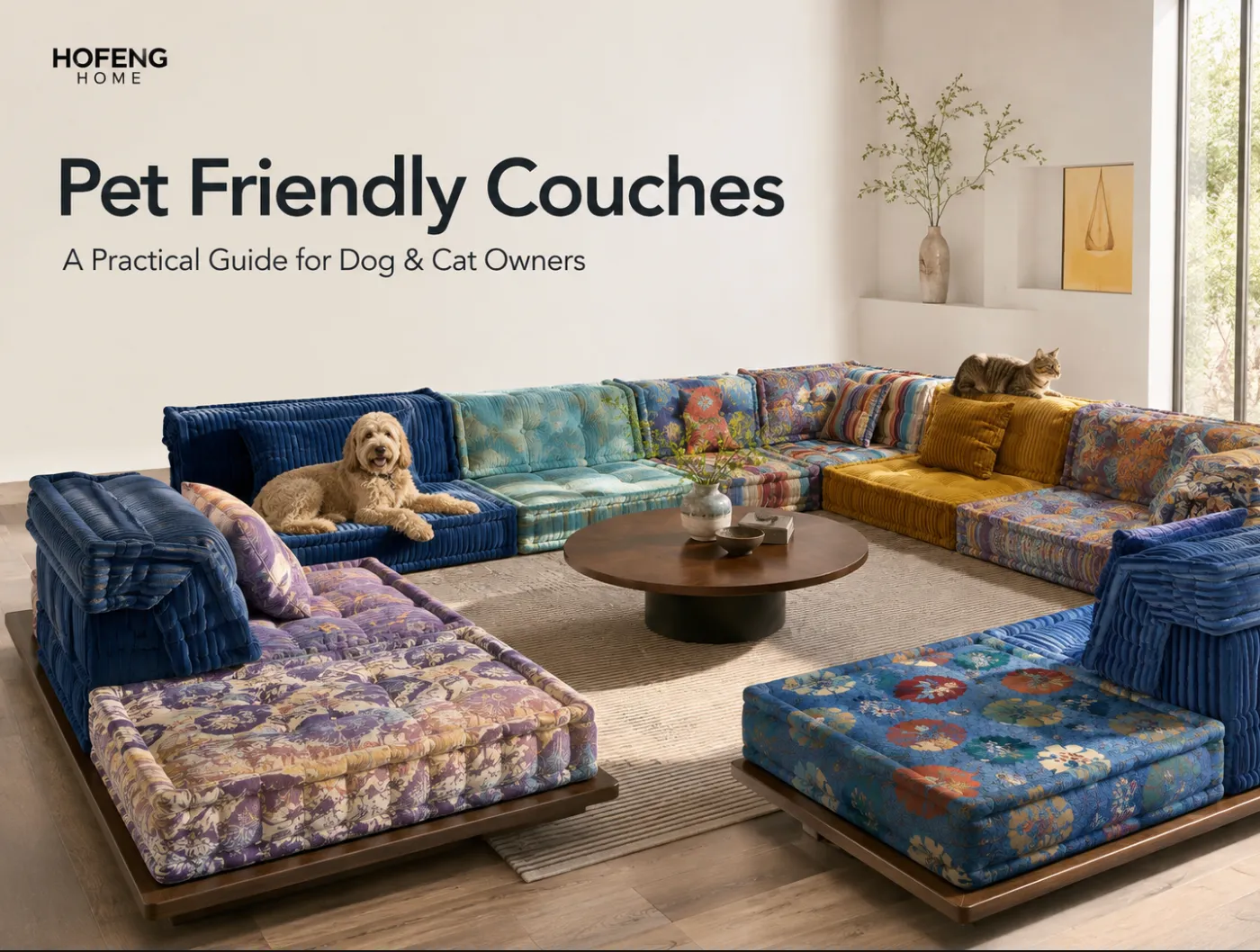
A sofa in a pet household has a harder job than simply providing comfortable seating. It may need to handle shedding, muddy paws, occasional spills or accidents, repeated jumping, claws, toys, and frequent cleaning while still looking appropriate in the room. That is why choosing pet friendly couches is less about finding a product carrying a “pet-proof” label and more about understanding how upholstery, construction, configuration and maintenance work together.
No sofa is literally pet-proof. A determined cat can damage many upholstery surfaces, a large dog can introduce substantial wear, and even a high-performance textile can stain when cleaned incorrectly. A more useful definition is this: a pet-friendly sofa is furniture selected and configured to make common pet-related wear easier to prevent, manage and maintain.
For most households, the strongest starting points are a relatively tight upholstery structure, appropriate cleanability, colors or patterns that make everyday hair less visually obvious, cushions and edges suited to the pet’s habits, and a configuration that leaves enough room for both people and animals. Fabric specifications matter, but one impressive abrasion-test number should never be treated as proof that a textile is claw-proof or will last for a particular number of years.
The right choice also differs between households. A couch for two shedding dogs has different priorities from a sofa for cat owners worried about snagging. A modular sectional in a large family room has different maintenance requirements from a pet friendly loveseat in an apartment.
This guide explains how to evaluate those differences and choose a sofa around your pet, your room and your maintenance tolerance, rather than relying on a generic “best sofa for pets” claim.
A pet friendly couch is a sofa whose upholstery, construction, layout and maintenance requirements are compatible with the predictable stresses created by pets. Those stresses typically include hair, claws, moisture, dirt, repeated movement and more frequent cleaning.
The key word is compatible. A textile that performs well in one household may be frustrating in another. Smooth upholstery may make loose dog hair easier to remove, for example, while a cat that actively scratches furniture introduces a completely different requirement: reducing opportunities for claws to catch and pull yarns.
This is also why “pet safe couch,” “pet resistant couch” and “pet proof couch” should not be treated as technical certifications unless a manufacturer explicitly identifies the relevant test or standard. In ordinary shopping language, they describe intended suitability rather than immunity from damage.
Before comparing upholstery swatches, identify what actually happens in your home.
A long-haired dog may make hair removal the main concern. A puppy may make moisture, dirt and frequent cleaning more important. Cats that climb or scratch can make surface construction and exposed upholstery edges a priority. Older animals may benefit from a seating arrangement that does not require unnecessarily difficult jumps, although any pet-specific mobility concern should be considered individually.
Then ask where the pet spends time. A dog that is not allowed on furniture creates a very different wear pattern from one that sleeps on the sectional every evening.
That simple assessment prevents a common purchasing mistake: paying for a feature marketed as “pet friendly” that does not address the household’s actual problem.
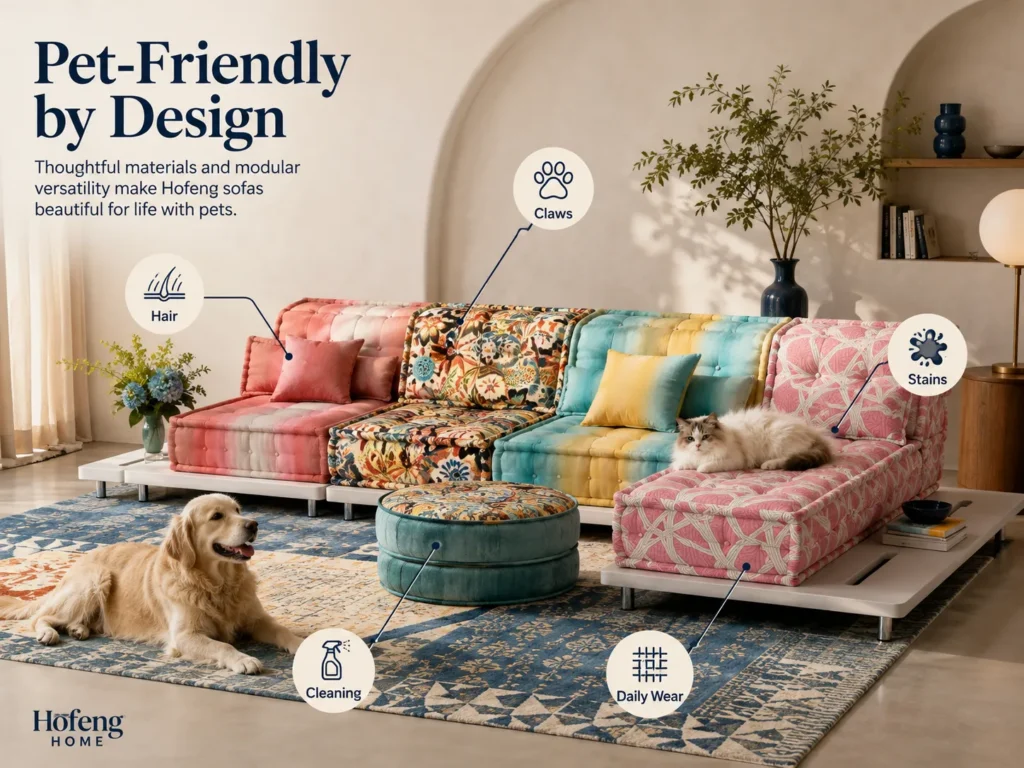
There is no single pet friendly sofa material that is automatically right for every dog and cat. Instead, evaluate upholstery across several characteristics: surface structure, snag potential, cleanability, resistance to everyday abrasion, hair visibility, colorfastness and the manufacturer’s care instructions.
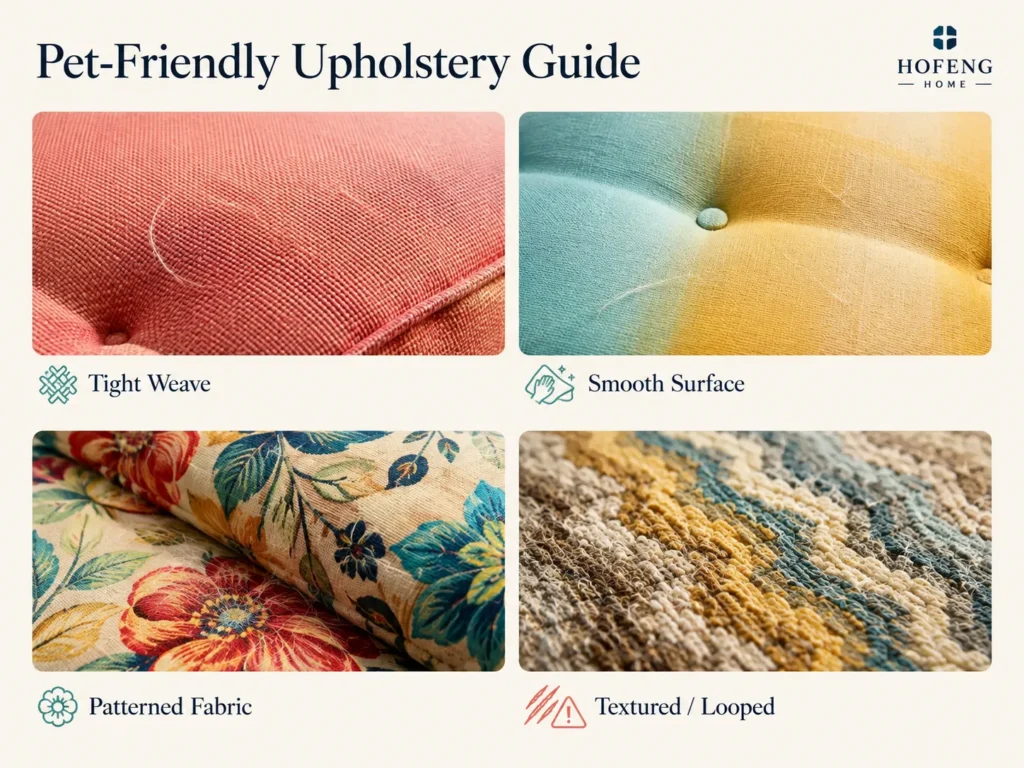
For households concerned about claw snagging, examine the physical surface rather than relying solely on the fiber name. Loops, prominent yarns and highly open constructions provide more opportunities for claws to catch than many compact, smoother constructions.
That does not mean every tightly woven fabric is “cat proof.” A cat can still scratch it. The practical advantage is simply that there may be fewer easily accessible loops or loose yarns to pull.
This distinction matters when comparing materials such as boucle, chenille, velvet-like surfaces, woven polyester and microfiber-type upholstery. Two fabrics within the same broad category can perform very differently because yarn size, weave, backing, finishing and construction vary.
For a best couch for cat owners search, therefore, “What does the surface look and feel like up close?” is often more useful than “What fiber is it?”
Furniture shoppers often encounter Martindale cycles or Wyzenbeek double-rub results. These tests measure abrasion: surface wear caused by rubbing. They are useful specification tools, especially when comparing upholstery intended for different usage levels.
The Association for Contract Textiles (ACT), for example, lists 30,000 Wyzenbeek double rubs or 40,000 Martindale cycles in its voluntary high-traffic guideline for woven indoor upholstery used in public spaces. Crucially, ACT also warns that results above its abrasion guideline do not predict product lifespan, that test results can vary substantially, and that Wyzenbeek and Martindale results should not be directly correlated.
That is particularly important for pet owners. Abrasion testing is not the same thing as testing whether a cat’s claw will snag a particular weave. Nor does a high abrasion figure prove resistance to urine, saliva, staining, odor or inappropriate cleaning products.
Treat abrasion performance as one part of the upholstery specification, not a universal pet-proof score.
A pet durable couch that is extremely difficult to clean may still be a poor practical choice.
Before ordering, ask for the exact cleaning instructions for the selected upholstery. Determine whether routine vacuuming is appropriate, how spills should be treated, whether covers are removable, whether professional cleaning is recommended and which cleaning products must be avoided.
Do not assume “performance fabric” means machine washable, waterproof or safe to clean with bleach. Those are separate characteristics that must be confirmed for the specific textile.
If removable covers are important, confirm both removability and permitted cleaning method. A removable cover is not automatically a washable cover.
Leather can make loose hair relatively easy to see and remove because fur does not become embedded in a woven structure. The trade-off is that claws can mark or puncture the surface.
Consequently, leather should not be presented as universally the best sofa for cats or dogs. Its suitability depends on the animal’s behavior, the leather type and finish, and the owner’s tolerance for visible marks and natural surface change.
The following table is a practical screening tool rather than a durability ranking. Exact performance depends on the individual textile.
| Upholstery characteristic | Potential advantage | Potential concern | What to confirm before buying |
|---|---|---|---|
| Tight, compact weave | Fewer obvious loops for claws to catch | Can still be scratched or stained | Weave structure, abrasion data, cleaning instructions |
| Smooth synthetic upholstery | Hair may be easier to remove; broad performance options | Performance varies significantly by construction | Fiber content, finish, care method |
| Microfiber-type surface | Dense surface can simplify routine maintenance | Quality and stain behavior vary | Actual sample and cleaning code |
| Velvet-like surface | Short, dense surface may have fewer exposed loops | Hair can remain visually noticeable on some colors | Pile direction, cleaning requirements |
| Leather | Loose hair can be easy to wipe away | Claws can leave visible scratches or punctures | Leather type, finish and care instructions |
| Loose/looped texture | Strong decorative character | Greater potential for snagging in claw-active homes | Test a physical swatch before ordering |
| Patterned fabric | Can visually disguise some loose hair and minor marks | Pattern matching affects custom manufacturing | Repeat size, direction and seam placement |
The strongest purchasing decision rarely comes from picking the material with the highest theoretical rating. It comes from matching the textile to how the furniture will actually be used.
The best couch for pet hair is usually one that makes hair reasonably easy to remove without making every strand immediately visible.
Surface structure matters because fur can become embedded in pronounced textures. Color matters because contrast determines how visible shedding appears between cleanings.
If your pet sheds pale fur, a solid charcoal sofa may make every strand obvious. The reverse happens with dark fur on very light upholstery. A mid-tone textile, subtle multicolor weave or controlled pattern can sometimes reduce visual contrast more effectively than trying to match one exact fur color.
Hofeng Home’s upholstery customization is relevant here because a modular sofa can be planned not only around a color palette but around pattern, texture and placement across individual modules. The final textile should still be evaluated for maintenance and suitability rather than selected for appearance alone.
[Internal Link: Upholstery/Customization Page + Recommended Anchor Text: explore upholstery customization options]
Patterned upholstery introduces an additional manufacturing issue: pattern direction and alignment.
A stripe running vertically on one seat and horizontally on the adjacent module will be immediately noticeable. Large floral or geometric repeats may also need deliberate placement where seats, backs and neighboring modules meet.
For custom pet-friendly living room furniture, therefore, the specification should identify the fabric reference, orientation and any pattern-matching expectations before production. This is both an aesthetic issue and a manufacturing issue because repeat size and placement can influence fabric consumption and cutting.
The best sofas for dog owners combine manageable upholstery with a configuration that suits the dog’s habits and the household’s seating needs.
For an active dog that regularly comes indoors after walks, cleanability may dominate the decision. For a heavily shedding dog, routine vacuuming and hair removal become more important. For a dog that sleeps on the sofa, cushion stability and sufficient shared seating area deserve more attention.
A large sectional can work particularly well when people and pets routinely share the room because the available surface can be distributed across several seating positions. A smaller pet friendly loveseat, however, may make more sense when floor space is the limiting factor.
A pet friendly sectional sofa can be useful when the household needs flexibility rather than simply maximum size.
With independent modules, the arrangement can potentially be adapted as the room or household changes. Hofeng Home’s customizable Mahjong-style modular system, for example, can be configured from independent modules that may be combined, rotated, expanded or rearranged depending on the selected configuration and technical feasibility.
That can help in open-plan living rooms where seating also acts as a zoning element. Instead of automatically pushing a large sofa against a wall, modules can define the living area while preserving circulation around the furniture.
For pet households, map the animal’s usual route as well. If the dog constantly crosses one corner between a door and the garden, placing a delicate upholstered edge directly in that traffic path is not clever space planning, regardless of how good it looks in a rendering.
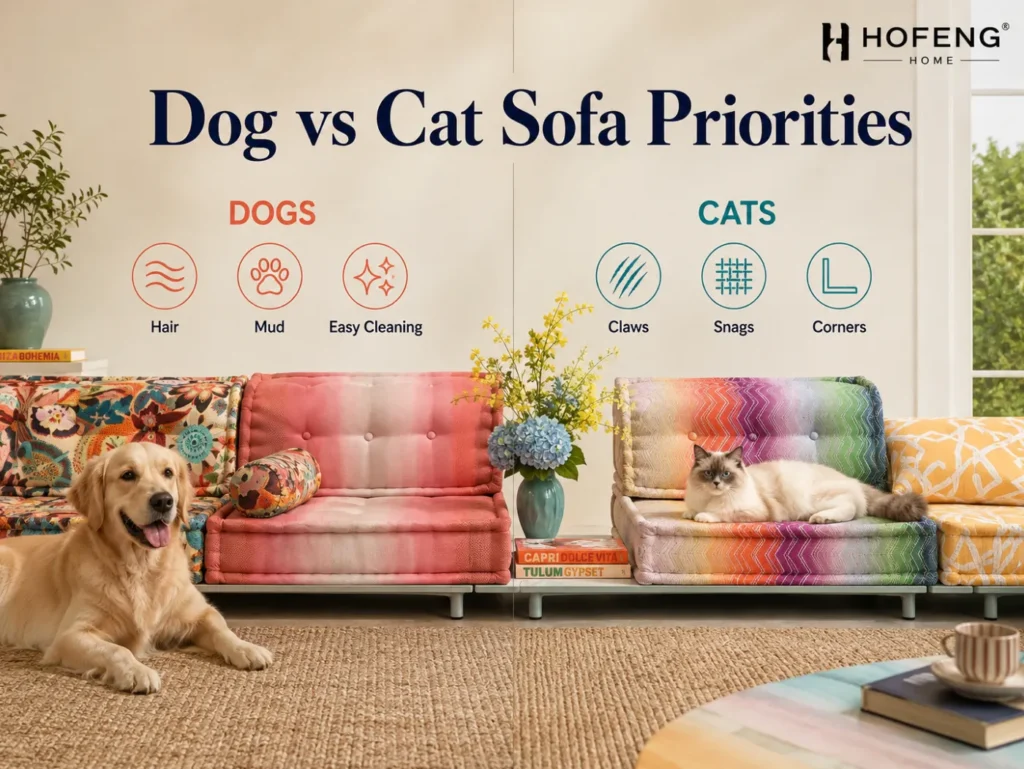
For cat owners, upholstery surface construction is often one of the first specifications to examine.
Cats scratch for normal behavioral reasons, so calling any upholstered sofa a cat proof couch creates unrealistic expectations. The more useful goal is to choose a surface that does not unnecessarily invite snagging and to provide appropriate scratching alternatives in the room.
Closely inspect samples for loops and prominent yarns. Run your hand lightly across the material and look at it from several angles. A highly dimensional textile may look excellent in a showroom but become harder to maintain if a cat repeatedly catches its claws in the surface.
Corners and exposed sides also deserve attention. Cats do not interact only with seat cushions; vertical upholstered areas can become scratching targets. When planning a sofa for cat owners, consider the complete upholstered envelope.
Two “polyester” textiles can have very different textures. Two velvets can differ in pile, backing and maintenance. Two patterned fabrics can behave differently around claws because their structures are not identical.
For custom furniture, request or review the actual upholstery reference whenever possible. For designers and project buyers, approve the correct colorway and maintain a clear material reference so that the production specification does not depend on vague terms such as “blue performance fabric.”
A modular sofa does not automatically resist pets better than a traditional sofa. Its advantage is configuration flexibility.
| Consideration | Modular sofa | Conventional fixed sofa |
|---|---|---|
| Layout changes | Modules can be rearranged where the design permits | Usually remains one fixed configuration |
| Room changes | Can offer more flexibility when moving or replanning | Fit depends on fixed overall dimensions |
| Zoning | Useful for defining open-plan spaces | Works well in straightforward layouts |
| Specification | Requires module-by-module planning | Generally simpler to specify |
| Upholstery coordination | Can combine planned colors/patterns across modules | Usually one continuous design language |
| Pet household planning | Different modules can be positioned around household traffic | Pet use is managed within one fixed form |
A sectional couch good for dogs is therefore not necessarily the biggest sectional available. It is one whose footprint, seat proportions, upholstery and configuration fit the people, pets and circulation of the room.
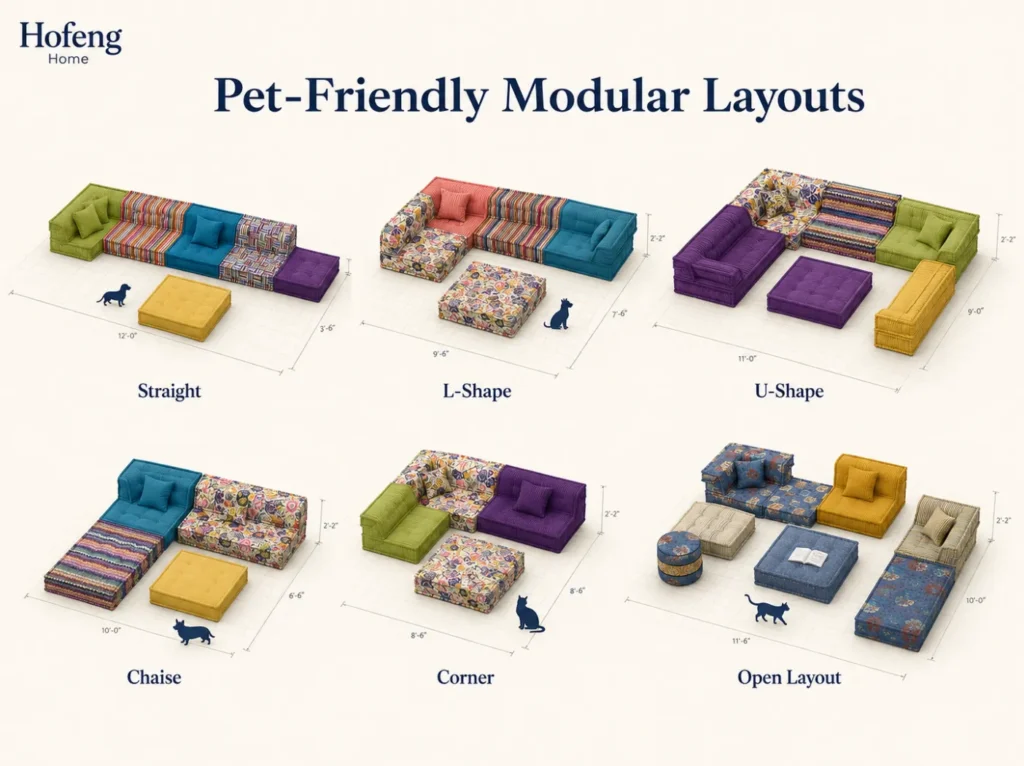
Pet ownership does not change the basic rules of furniture planning. A beautiful sofa that obstructs a doorway or overwhelms a small living room is still the wrong sofa.
Start with the available floor area, then map doors, windows, radiators or vents where applicable, tables and major circulation routes. Measure delivery access separately from the final furniture location.
With modular seating, document the individual module dimensions and complete assembled footprint. The second measurement is easy to overlook. A series of modules that appear manageable individually can form a very large arrangement once combined.
Interior designers routinely consider human circulation. In a pet household, animal movement adds another layer.
A dog may repeatedly move between the sofa, water bowl and exterior door. A cat may use the back of the sofa as part of a preferred route through the room. Recognizing these habits can influence module placement and upholstery selection.
This is where pet-friendly living room furniture becomes a room-planning question rather than a sofa-only question. Rugs, ottomans and tables should work with the seating arrangement rather than create a maze of narrow passages.
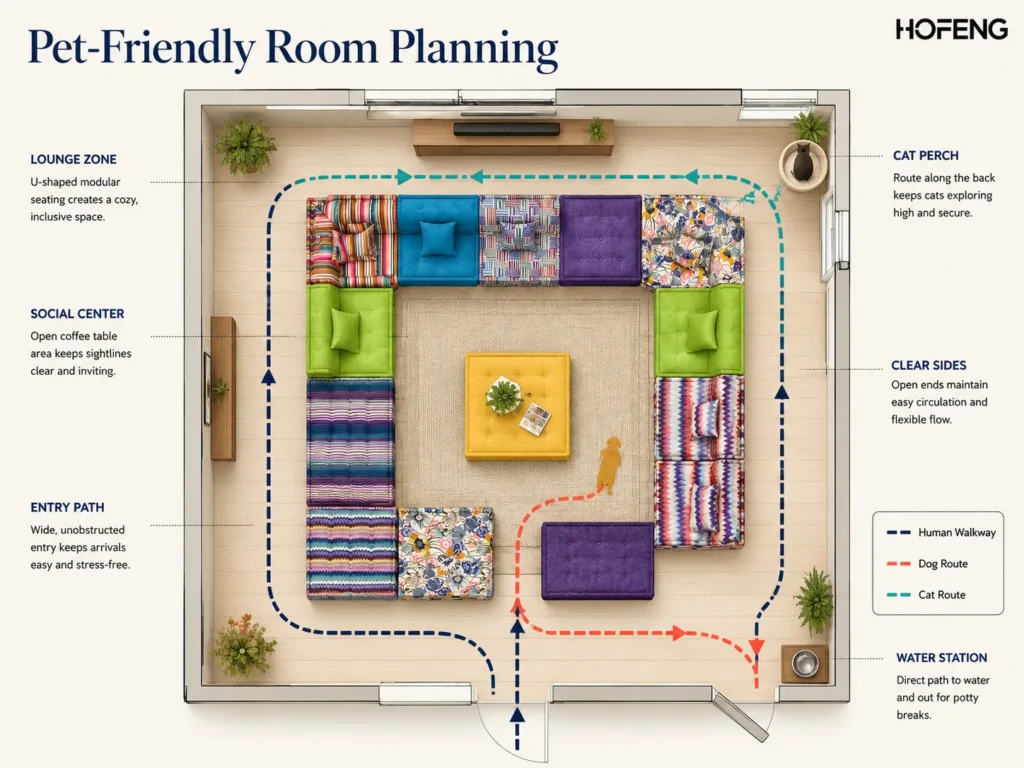
A common mistake when shopping for pet resistant couches is becoming so focused on durability that human comfort becomes secondary.
Seat depth, seat height, back angle, cushion construction and upholstery feel all affect how a sofa feels. A material can be extremely practical and still be unpleasant for the household if its tactile character is wrong.
Consider how people actually sit. Upright conversation, reading, lounging and curling up with a dog do not demand exactly the same proportions. In a custom project, comfort expectations should therefore be communicated alongside pet-related requirements.
For a household searching for the most comfortable pet friendly sofa, there is no universal winning specification. Comfort is personal; pet compatibility is contextual. The strongest solution balances both rather than maximizing one metric.
Upholstery receives most of the attention, but a sofa is a system. Cushions, seams, edges, structural support and module interfaces all influence long-term appearance and usability.
Pets frequently return to the same position. Humans do too. That means one seat can receive substantially more use than another.
Ask how the cushion system is constructed and what maintenance the manufacturer recommends. Depending on the design, periodic rotation or repositioning may help distribute wear, but not every cushion is reversible or removable.
Avoid assuming that a particular foam density automatically identifies the “best” cushion. Density, firmness and overall cushion construction describe different characteristics and should be evaluated as a system.
Seams are visually small but technically important. Poorly planned seam placement can become conspicuous across adjacent modules, particularly with stripes or directional patterns.
Upholstery tension also affects appearance. During custom production, fabric characteristics must be considered when upholstering curved areas, corners, tufted surfaces and separate modules. A textile that behaves predictably on a flat cushion may behave differently around complex forms.
A modular arrangement relies on neighboring pieces looking intentional together. Manufacturers therefore need to manage dimensions, upholstery direction, edge finishing and color consistency across the order.
With patterned fabric, this becomes more demanding. The design team and buyer should establish whether pattern matching is expected across adjacent modules and what visual result is acceptable.
These are practical manufacturing details that matter to homeowners, but they become especially important for designers, retailers and project buyers ordering repeated configurations.
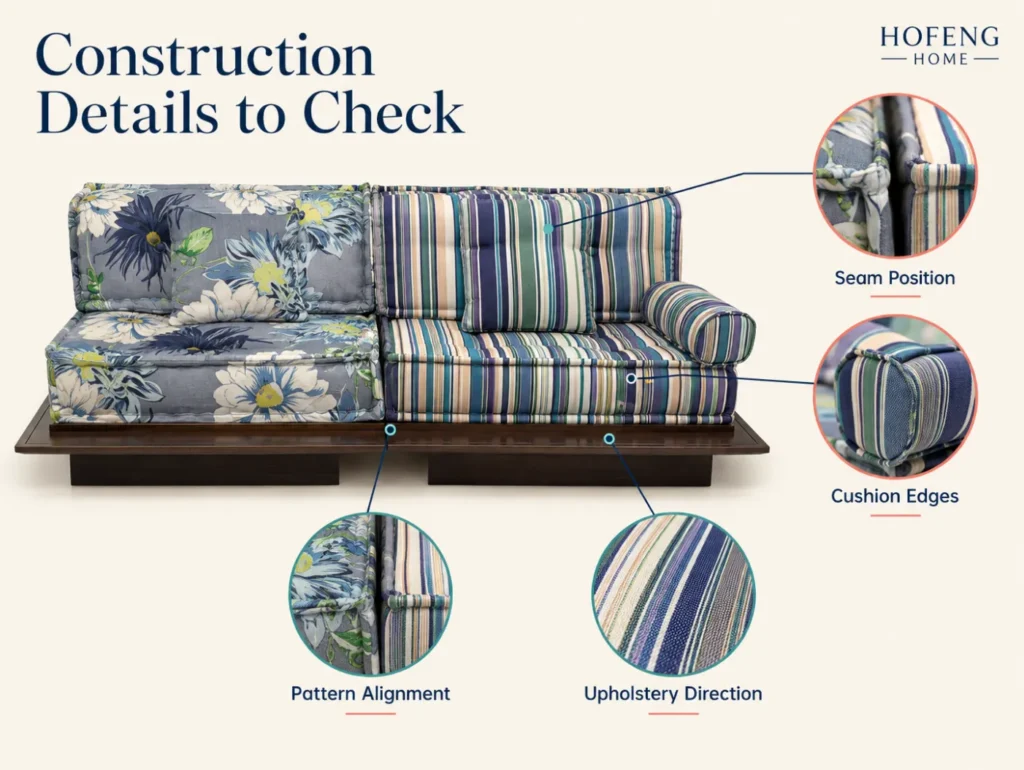
Good maintenance begins with the upholstery manufacturer’s instructions, not a viral cleaning trick.
For routine care, remove loose hair and debris before it becomes embedded. A vacuum attachment suitable for upholstery can be useful where permitted by the textile’s care instructions. Attend to spills promptly using the method specified for the fabric, and avoid aggressively rubbing a stain because that can spread contamination or affect the surface.
A simple pet-household routine is usually enough:
Be particularly careful with “washable,” “stain-resistant,” “water-resistant” and “waterproof.” They do not mean the same thing.
“Pet safe” can be an ambiguous marketing phrase. If safety is important, ask exactly what the seller means by it.
For example, a buyer may be asking about chemical composition, exposed hardware, furniture stability, cleaning-product compatibility or regulatory compliance. Those are separate questions and require separate evidence.
International buyers should also distinguish pet friendliness from product compliance. Pet resistance does not replace the legal requirements applying to upholstered furniture in the destination market.
In the United States, CPSC states that federal upholstered-furniture flammability requirements are codified in 16 CFR Part 1640, incorporating the relevant requirements of California TB 117-2013, with testing and labeling obligations for covered products.
In the UK, amendments to the Furniture and Furnishings (Fire) (Safety) Regulations came into force on 30 October 2025. Businesses supplying domestic upholstered furniture should check the current rules rather than relying on an outdated compliance checklist.
For EU consumer products, Regulation (EU) 2023/988 establishes general product-safety requirements for products placed or made available on the market.
For an international OEM/ODM project, destination-market requirements should therefore be identified during specification development rather than treated as an afterthought.
Customization is most valuable when it solves a defined problem.
Instead of requesting “a pet-proof sofa,” create a specification describing the household or project. Include room dimensions, intended configuration, desired seat proportions, pet type and behavior, preferred upholstery appearance, maintenance priorities and any market-specific requirements that need confirmation.
For a modular project, the specification should identify:
Hofeng Home supports customizable modular sofa systems, upholstery customization and factory-direct OEM & ODM projects. Requested dimensions or configurations still require production evaluation because not every change is structurally appropriate.
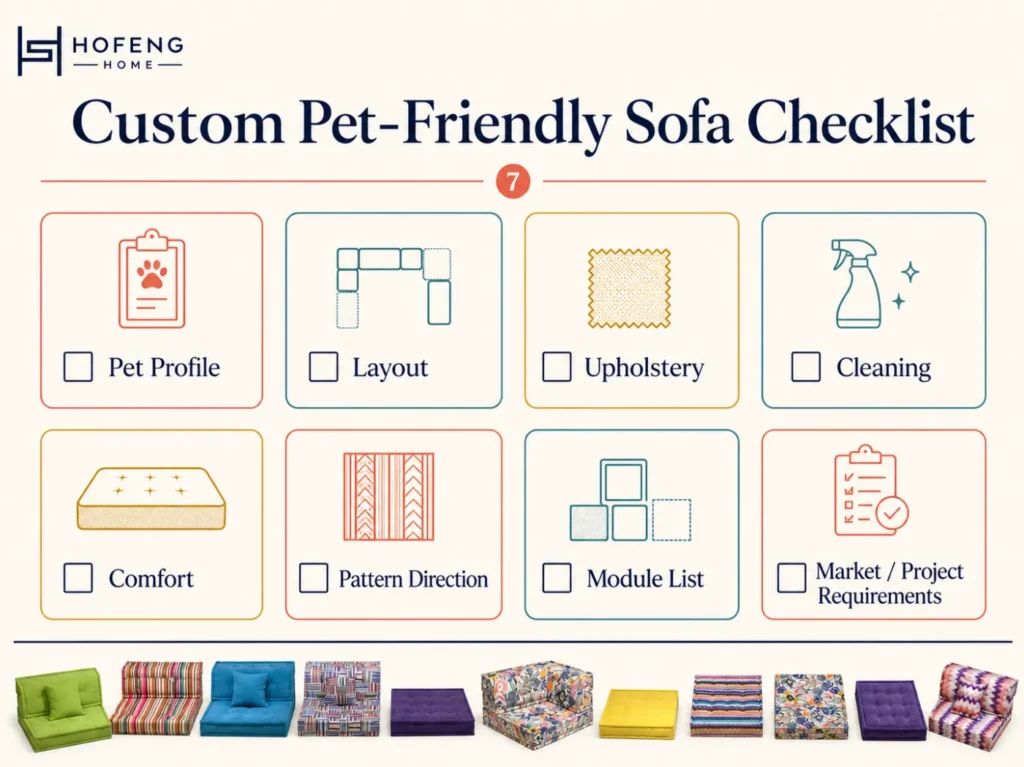
For retailers, interior designers and project buyers, pet friendly furniture cannot remain an informal brief. It needs to become measurable purchasing criteria.
If a retailer wants a pet-oriented collection, for example, the specification might prioritize compact upholstery structures, documented textile-performance information, defined cleaning instructions, repeatable colors and consistent construction across multiple modules. A designer specifying a residential project may care more about pattern placement, room circulation and coordinating a pet-friendly sofa with an artistic rug or ottoman.
Material confirmation is particularly important. The approved sample should correspond to the actual textile reference and colorway. If the project depends on a particular performance characteristic, request supporting documentation relevant to that characteristic rather than assuming that “performance fabric” covers everything.
Quality inspection should likewise reflect the design. Relevant checkpoints can include overall and module dimensions, visible upholstery defects, seam positioning, pattern direction, alignment between modules, color consistency and finishing.
Packaging and logistics belong in the conversation too. Modular furniture can contain multiple pieces that must arrive identifiable and in the correct configuration. For international projects, clear module identification and documentation can make receiving and installation considerably easier.
The first mistake is believing the word proof. Furniture can be more resistant to certain forms of wear, but no normal upholstered couch is immune to every claw, stain or accident.
The second is shopping by fiber name alone. “Polyester,” “velvet” or “leather” does not tell you everything about surface construction, finish or cleanability.
The third is treating an abrasion-test result as a lifespan prediction. ACT specifically cautions against doing so.
The fourth is choosing only by color. A perfectly camouflaging color is not useful if the surface is difficult to maintain for the household.
The fifth is ignoring the pet’s behavior. A couch for dog owners and a couch for cat owners may require different priorities even in otherwise identical rooms.
Finally, custom buyers sometimes approve the overall appearance without documenting the details. Module orientation, dimensions, fabric direction, pattern placement and finish expectations should be resolved before production wherever possible.
There is no universally best material. For many households, a compact, relatively smooth upholstery with suitable cleanability is a sensible starting point, but the correct choice depends on claws, shedding, moisture, staining risk and maintenance habits.
A sofa for cat owners should minimize easily snagged surface structures and be easy to maintain. Inspect actual fabric samples because cats can still damage materials marketed as scratch-resistant, and no upholstered sofa should be assumed to be completely cat proof.
The best sofa for dogs combines appropriate upholstery, sufficient seating area, manageable cleaning and a configuration suited to the dog’s habits. Shedding, muddy paws, size and whether the dog is allowed on the sofa should influence the specification.
They can be, depending on the specific material. A dense microfiber-type surface may offer practical maintenance advantages, but buyers should still verify cleaning instructions, stain performance and the actual surface with a sample rather than relying on the material name.
Relatively smooth surfaces can make loose hair easier to remove, while medium tones, subtle patterns or multicolor textures may make shedding less visually obvious. Match the choice to your pet’s fur and test a physical swatch where possible.
Leather can make loose fur easy to remove, but claws can scratch or puncture it. It may suit some dog households better than claw-active cat households, although the result depends on the animal and the specific leather and finish.
Yes, a sectional can work well when dogs and people need substantial shared seating. A modular sectional adds configuration flexibility, but the assembled footprint, circulation space and upholstery still need to suit the room.
No. These tests measure abrasion, not complete resistance to claws, stains, hair or pet accidents. ACT specifically warns that abrasion results above its performance guidelines should not be interpreted as predictions of fabric lifespan. contracttextiles.org
Yes, custom furniture can be planned around dimensions, layout, upholstery and other requirements where the manufacturer supports those options. Hofeng Home can evaluate custom modular configurations and upholstery selections, with final feasibility confirmed before production.
Ask about the exact upholstery reference and care instructions, available performance documentation, dimensions, cushion design, module configuration, pattern direction, customization feasibility and destination-market requirements. For custom projects, put agreed specifications in writing before production.
The most useful way to shop for pet friendly couches is to stop looking for an imaginary sofa that pets cannot damage and start designing around the wear your household actually creates.
For cat owners, that often means paying close attention to snag potential, exposed upholstered surfaces and scratching behavior. Dog owners may place greater emphasis on hair removal, dirt, moisture, repeated use and enough shared seating space. In both cases, cleanability matters alongside durability, and an impressive textile abrasion rating should be treated as one piece of evidence rather than proof that a sofa is pet-proof.
The room matters just as much. Measure the complete furniture footprint, protect circulation routes and consider how pets move through the space. Then evaluate human comfort: seat proportions, cushions and the tactile quality of the upholstery should still make the sofa enjoyable to use.
Customization becomes particularly valuable when those requirements cannot be solved by a fixed ready-made design. A modular system can help buyers adapt the layout to corners, open-plan rooms and changing spaces, while upholstery customization can coordinate texture, pattern and color with both practical needs and the interior scheme. For designers and B2B buyers, the same flexibility should be supported by disciplined specification: module dimensions, fabric references, pattern direction, finishing expectations and relevant destination-market requirements need to be clear before manufacturing begins.
Hofeng Home Furniture approaches this category as a custom furniture manufacturer and modular furniture solution provider, with customizable Mahjong-style modular sofa systems, upholstery options and OEM & ODM support for homeowners, designers, retailers and project buyers. Final dimensions, configurations and material selections remain subject to project and production evaluation.
If you are planning a pet-friendly living room or sourcing a customized modular collection, you can submit your room dimensions, preferred layout, upholstery direction and project requirements to Hofeng Home for configuration and manufacturing discussion. Discuss a custom furniture project now!

Hi, I’m Bella Lui! I’ve spent the past 10 years fully immersed in the custom furniture industry, with my biggest passion and expertise lying in tailor-made mahjong sofas. I’ve walked through full customization journeys with over 500 clients overseas, helping them craft one-of-a-kind modular seating that balances gaming comfort, home style and space limits.
Every blog post comes from real on-site experience: factory visits, client consultations, upholstery trials and hundreds of solved custom design headaches. I’m here to share everything you need to know before ordering a custom mahjong/modular sofa—no confusing jargon, just honest, actionable advice based on a decade of hands-on client projects.