
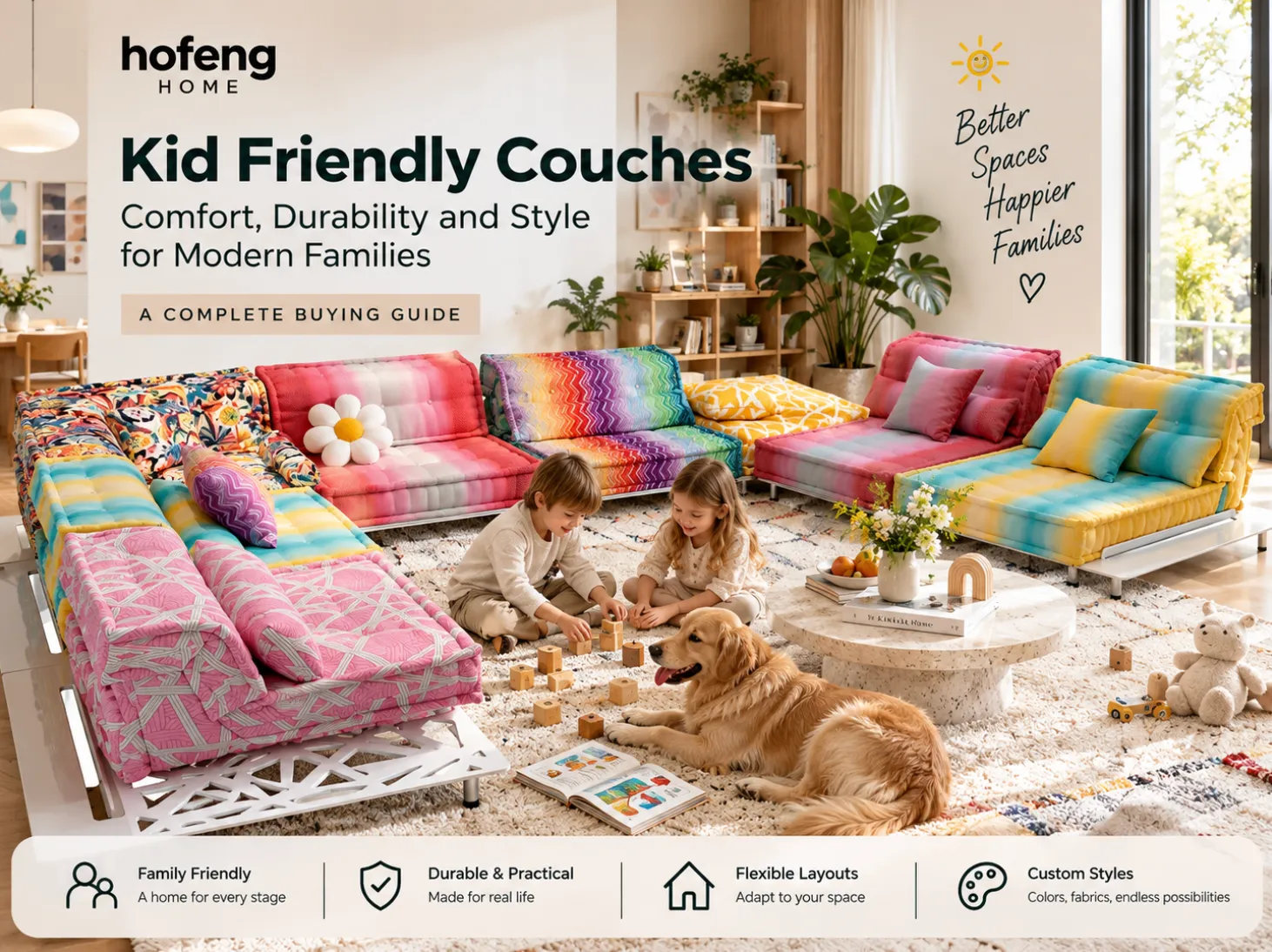
The hardest part of choosing kid friendly couches is that children do not use a sofa the way adults do. A family couch can become a place for movie nights, afternoon naps, snacks, homework, visiting relatives and everyday play, sometimes within the same day. Spills, crumbs and repeated use are normal rather than exceptional.
That changes what matters when buying furniture. A beautiful upholstery swatch is not enough. Families need to consider how easily the textile can be maintained, whether its surface suits frequent use, how the cushions behave, whether the sofa fits normal circulation through the room, and whether the configuration can continue working as the household changes.
There is also an important distinction between kid friendly, kid proof and child safe. “Kid friendly” is a practical description of furniture designed or selected around family life. “Kid proof sofa” is generally marketing language; no upholstered sofa is immune to staining, wear or misuse. “Child safe,” meanwhile, is a stronger safety claim that should not be assumed merely because furniture is soft, low-profile or rounded.
For most families, a good kid friendly couch combines appropriate upholstery, manageable cleaning requirements, comfortable proportions, sensible room planning and construction suitable for its intended use. Modular furniture can add another advantage: instead of committing permanently to one large arrangement, families may be able to reorganize individual modules as rooms and needs change.
This guide explains how to choose a couch for a family, from upholstery and comfort to modular planning, manufacturing details, maintenance and international purchasing considerations.
A kid friendly couch is a sofa whose materials, dimensions, configuration and maintenance requirements are appropriate for the realities of family use.
That does not mean every family needs the same specification. A household with a toddler and a compact apartment has different priorities from a family with teenagers, a large open-plan room and frequent guests.
Instead of asking only, “What is the best sofa for kids?” start with four practical questions:
These answers make it easier to separate genuinely useful features from marketing claims.
The phrase kid proof couch suggests that a sofa can resist anything children do to it. In real homes, that is unrealistic.
Fabric can be stained by substances it was not designed to resist. Seams can be damaged by excessive force. Cushions can change shape with repeated use. Even removable upholstery can be damaged if it is cleaned using a method the textile manufacturer does not permit.
A better purchasing goal is manageable wear: choose furniture that makes common family messes easier to prevent, clean and live with.
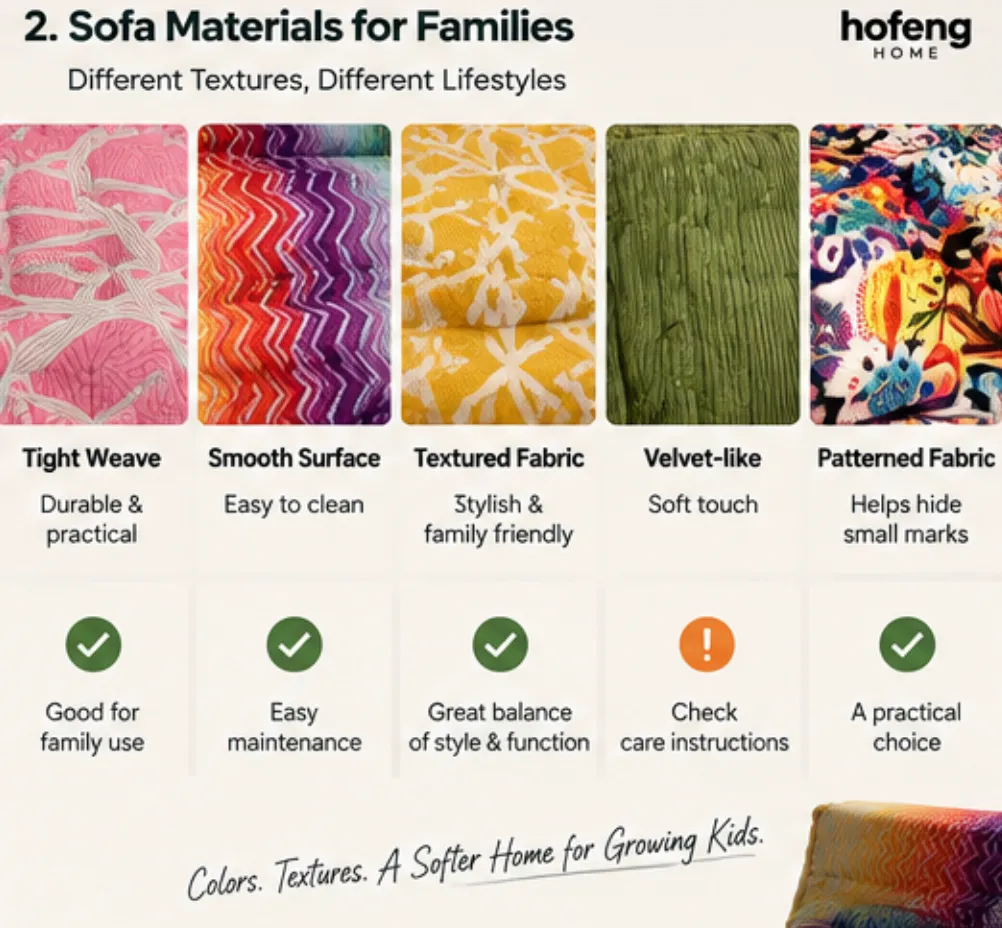
The best couch material for kids is not simply “polyester,” “velvet,” “leather” or another single fiber category. Upholstery performance depends on its complete construction, including yarn, weave or knit structure, surface texture, backing, finish, dyeing, seam behavior and permitted cleaning methods.
Two fabrics made from the same fiber can perform very differently.
For a busy family room, examine the textile closely.
Tighter, more compact upholstery constructions are often easier to assess for regular use than very loose, open textures. Pronounced loops and highly dimensional surfaces can collect crumbs or experience visible surface disturbance differently from flatter fabrics.
That does not make textured upholstery unsuitable for families. It means the decorative effect should be balanced against the household’s cleaning habits.
Families should physically inspect fabric samples whenever possible. Look at them under natural and artificial light, touch the surface, bend the swatch and consider whether small debris would be easy to remove.
Martindale and Wyzenbeek figures are frequently used to market durable sofas, but these numbers need context.
The Association for Contract Textiles (ACT) defines abrasion as surface wear caused by friction. For woven upholstery intended for high-traffic public spaces, its voluntary guideline identifies 30,000 Wyzenbeek double rubs or 40,000 Martindale cycles. More importantly, ACT explicitly cautions that abrasion results exceeding its guidelines should not be interpreted as predictions of product lifespan. ACT also states that there is no direct correlation between Wyzenbeek and Martindale results.
For family furniture, this matters because everyday durability involves more than abrasion. ACT’s broader performance framework also considers factors such as physical properties, color transfer and colorfastness depending on the textile and application.
In practical terms, do not choose a family couch merely because one fabric advertises a very large rub-count number.
A fabric that survives repeated rubbing but is difficult to clean may still be frustrating in a home with young children.
Before buying, confirm the permitted cleaning process for the exact upholstery selection. Ask whether it is intended for vacuuming, spot cleaning, professional cleaning or another method.
Be careful with commonly confused terms:
Removable does not necessarily mean machine washable.
Stain resistant does not mean stain proof.
Water resistant does not mean waterproof.
Performance fabric is not one universal technical specification.
These distinctions matter more than they sound. A parent choosing between two attractive fabrics may find that maintenance instructions are ultimately the deciding factor.
The following table is a screening guide, not a ranking. Actual performance depends on the individual material.
| Upholstery characteristic | Potential family advantage | Potential drawback | What to verify |
|---|---|---|---|
| Tight, compact weave | Practical surface for frequent use; debris may be easier to manage | Individual fabrics vary significantly | Cleaning method, abrasion data, seam behavior |
| Smooth synthetic upholstery | Broad range of colors and performance options | Fiber name alone does not predict quality | Construction, finish and care instructions |
| Microfiber-type upholstery | Dense surface may be easy to maintain in some households | Appearance and stain behavior vary | Specific manufacturer’s care instructions |
| Velvet-like upholstery | Soft tactile character; strong color depth | Pile can show pressure or direction changes | Cleaning, pile behavior and intended use |
| Leather | Smooth surface can be straightforward to wipe | Scratches and marks may remain visible | Leather type, finish and maintenance |
| Bouclé/looped texture | Strong visual and tactile interest | Textured loops may retain debris or snag more easily | Sample evaluation and maintenance expectations |
| Patterned fabric | Can visually disguise small marks and support expressive interiors | Pattern matching adds manufacturing complexity | Repeat size, fabric direction, seam placement |
A family choosing between these options should weigh maintenance, comfort, appearance and intended usage together.
There is no universal best color for a family friendly couch. The most practical choice often depends on what kinds of marks the household wants to make less visually prominent.
Very light, uniform upholstery can make some stains obvious. Very dark solid upholstery can make pale crumbs, dust or pet hair more noticeable. Mid-tones, subtle multicolor weaves and controlled patterns can sometimes visually soften minor day-to-day marks between cleanings.
That does not mean families must choose beige or gray. Colorful furniture can work extremely well in a family room when the textile itself is appropriate for the intended use.
This is particularly relevant for custom upholstery. Hofeng Home Furniture can customize upholstery materials, fabric patterns, textures and colors for its modular systems, allowing appearance to be considered alongside the practical requirements of the project.
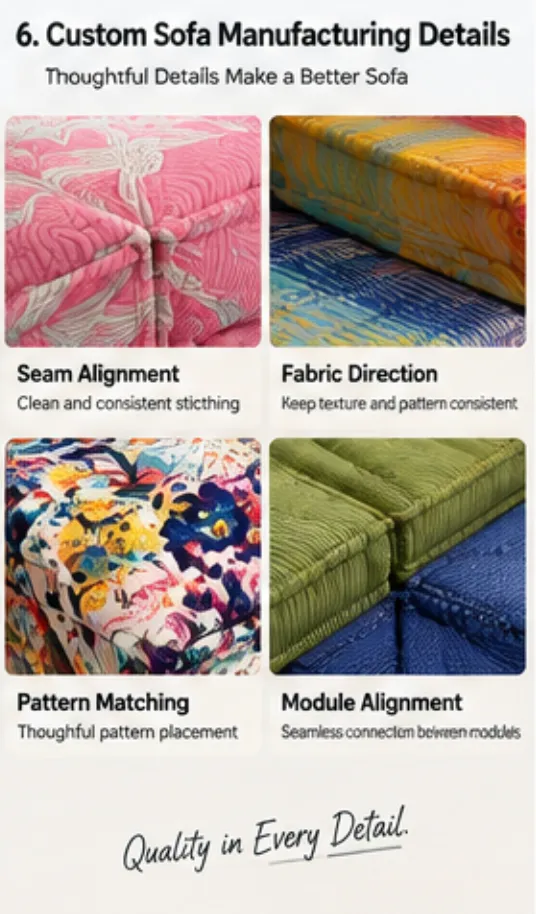
Patterns introduce a manufacturing question that solid fabrics largely avoid: where should the pattern go?
With stripes, checks, florals or large geometric designs, cutting direction affects the finished furniture. Adjacent cushions can look mismatched if one piece is cut vertically and another horizontally. A large motif may also appear awkward if it is cut through at a prominent seam.
For custom kid friendly furniture, specify pattern direction, important motif placement and whether adjacent modules are expected to visually align before production. Pattern matching may also affect material usage, so it should be discussed rather than assumed.
Parents sometimes become so focused on finding the most durable couches for families that they forget why the furniture exists in the first place.
A sofa still needs to be comfortable.
Seat depth, seat height, cushion construction, back support and overall proportions influence whether people want to sit upright, lounge, curl up together or stretch out during a movie.
A comfortable deep couch can work well for relaxed family rooms because it provides room for lounging and shared seating. But deeper is not automatically better.
Shorter users may need more back support on a very deep seat, while people who prefer upright conversation or reading may find shallower proportions more comfortable. Families also need to consider how much floor area a deep sofa occupies.
A sensible approach is to think about the household’s main activities:
If the room is mainly used for movies and relaxing, deeper lounge seating may suit the family. If it doubles as a formal receiving area, homework zone and conversation space, a more balanced seat depth may be preferable.
There is no universal most comfortable sectional because comfort depends on the users and the way they sit.
Cushion comfort is not determined by one impressive foam number.
Foam density, firmness, layering, fiber wraps, upholstery tension and cushion dimensions can all influence the feel and appearance of a seat. Because Hofeng Home has not supplied fixed foam specifications for this article, no specific foam value should be assumed for its furniture.
For custom projects, communicate the desired sitting experience instead: firmer and more upright, softer and more lounge-oriented, or something between the two. The manufacturer can then evaluate technically feasible options.
A kid friendly modular sofa does not automatically become more durable because it is modular. Its main advantage is flexibility.
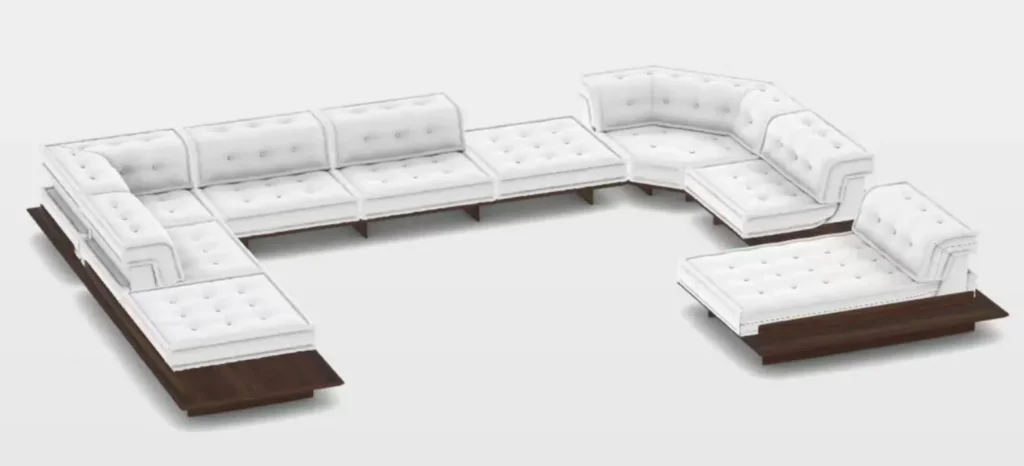
A conventional sofa has a largely fixed form. A modular system is assembled from separate furniture units, which can create different layouts when the system permits.
This distinction becomes useful as family life changes.
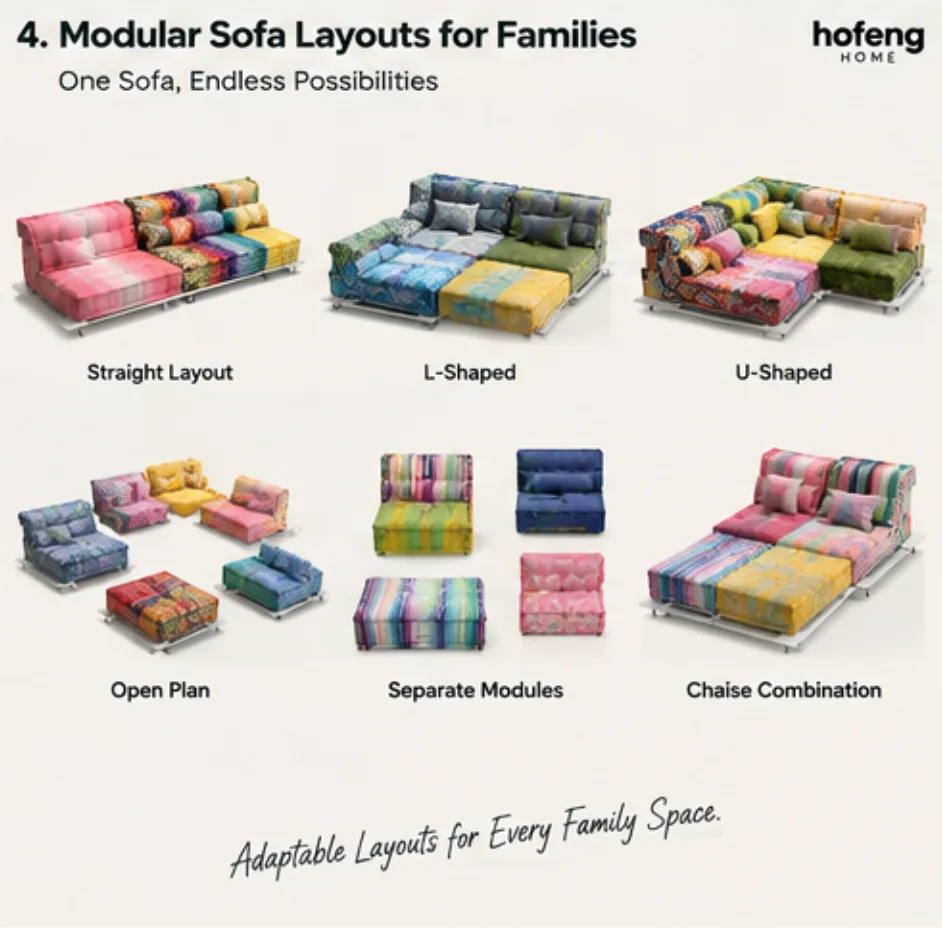
A couple might initially use three modules in a small apartment. After moving, the same concept could potentially be expanded into an L-shaped or open arrangement with additional compatible modules. A large living room may use separate pieces to create multiple conversation zones instead of one long line of seating.
Hofeng Home’s customizable Mahjong-style sofa system consists of independent modules that can be combined and rearranged into different configurations. Depending on the selected design, modules can be rearranged, rotated, combined, expanded or reconfigured. Requested dimensions or layouts remain subject to structural and production evaluation.
👉 Plan a custom modular sofa configuration
| Consideration | Modular sofa | Conventional sofa |
|---|---|---|
| Layout changes | Modules may be rearranged where the design allows | Overall form generally stays fixed |
| Future expansion | Compatible modules may allow configuration growth | Usually requires another separate furniture piece |
| Open-plan zoning | Multiple orientations can help define areas | Good for straightforward fixed layouts |
| Specification | Requires module-by-module planning | Usually simpler |
| Pattern coordination | Direction and matching may need detailed planning | Fewer module interfaces |
| Moving homes | Separate modules may offer more planning flexibility | Fixed overall size can limit placement |
| Custom projects | Strong potential for configuration-specific design | Customization depends on sofa construction |
The modular option is particularly useful when flexibility itself solves a real problem. There is little benefit in choosing modular furniture purely for the label if the household intends to keep one fixed configuration forever.
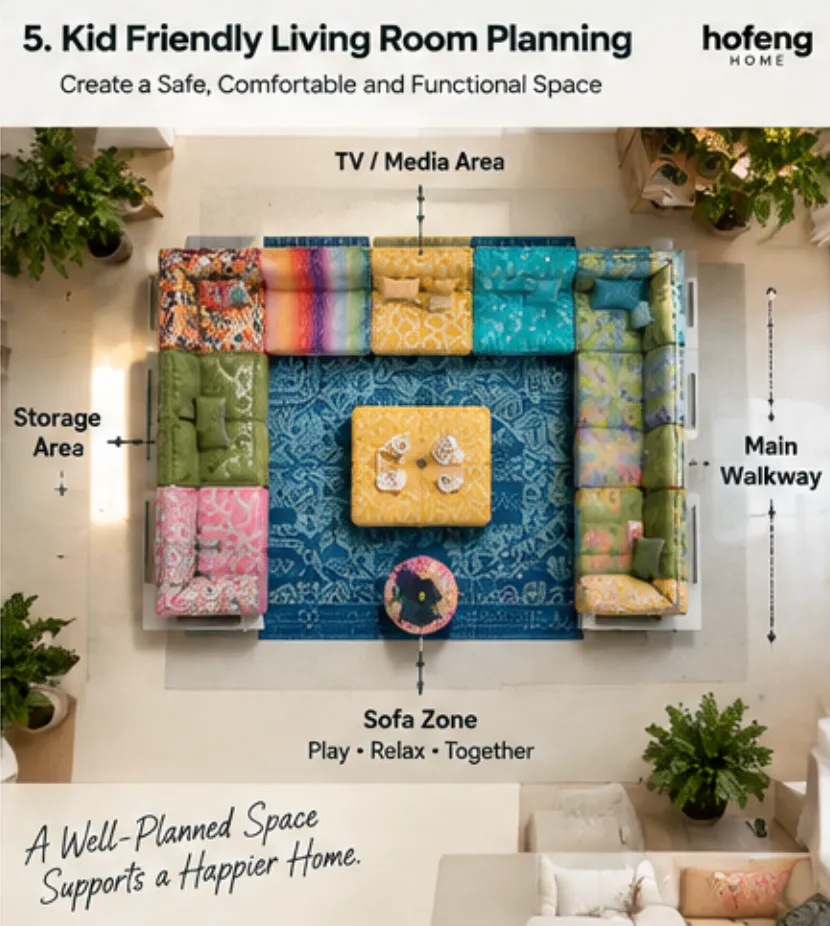
The best living room furniture for families has to fit the room before it can serve the family.
Start with accurate room measurements. Mark doors, windows, fixed architectural features and the main walking routes. Then place the intended sofa footprint on the plan.
For modular furniture, measure both the individual modules and the complete assembled configuration. A module may look compact on its own while several modules together create a very large sectional.
A family room usually has more movement than a formal living room.
Children may move repeatedly between seating, storage, dining areas and other parts of the home. Adults may carry food, laundry or household items through the same space. Furniture should not create unnecessarily awkward bottlenecks.
An oversized sectional that technically fits wall-to-wall can still be the wrong choice if it makes normal movement difficult.
For interior designers, circulation should therefore be resolved at the same time as the visual composition. Sofa scale, ottoman placement and rugs should create a coherent zone without making the seating area feel physically disconnected from the rest of the room.
In an open-plan home, the sofa often does more than provide seating. It helps define where the living area begins and ends.
An L-shaped or open modular arrangement can create a clear family zone without building a physical partition. Individual modules can also be oriented to support conversation rather than directing every seat toward a television.
This is one reason family room couch ideas should be developed from the floor plan rather than from isolated product photos.
Low-profile furniture can create a relaxed visual character and is often associated with contemporary lounge interiors. It may also change how furniture relates to the surrounding room because the back height occupies less visual space.
However, a low sofa should not automatically be described as a child-safe sofa.
Furniture safety involves more than seat height. Stability, construction, components, materials, intended use and applicable product requirements all matter. Nor should any sofa be treated as play equipment unless it is specifically designed and evaluated for that purpose.
For that reason, parents should distinguish an adult family sofa from a children’s couch, kid sofa, or dedicated kids play couch. These can be different product categories with different intended users and requirements.
The visible textile receives most of the attention during sofa shopping, but upholstery is only the outer layer of the product.
Construction quality also depends on how dimensions, cushions, seams, support, upholstery and neighboring components work together.
Seams influence both appearance and performance.
On a solid-colored sofa, small differences in seam location may be relatively subtle. On striped or strongly patterned modular seating, they become much more visible.
During production, manufacturers need clear information about the desired fabric direction on seat cushions, back cushions, side panels and adjoining modules.
Modular furniture depends on repetition.
If neighboring modules are intended to form one continuous sofa, dimensional differences can affect alignment between seats, backs and edges. Production control therefore needs to consider the relationship between modules rather than inspecting each piece only as an isolated item.
This becomes especially important on larger OEM/ODM orders where the same configuration may need to be repeated consistently.
Different textiles behave differently around furniture forms.
A flexible fabric may respond differently around curved corners than a rigid woven textile. Directional pile can change appearance when adjacent panels face different directions. Strong patterns can make even minor alignment differences obvious.
The correct upholstery process therefore depends partly on the textile selected.
Where separate sofa pieces are intended to remain together, the connection approach affects how the finished layout functions.
Connection methods vary between furniture systems, so buyers should ask how the proposed configuration is intended to assemble rather than assuming every modular sofa uses the same hardware.
Hofeng Home-specific connector details have not been confirmed here, so they should be verified during the project specification stage.
The most practical family sofa is usually one whose care requirements match the household’s habits.
If the family expects frequent food spills, occasional cleaning should not require a complicated process nobody will realistically follow. Conversely, choosing an upholstery merely because it is described as easy-care without reading its instructions creates its own risk.
Routine care can include removing loose debris, dealing with fresh spills promptly according to the textile instructions and inspecting heavily used areas.
Avoid automatically using strong household cleaning chemicals. A product that is safe for a kitchen counter is not necessarily appropriate for dyed upholstery.
For removable cushions, confirm whether they can be rotated or reversed. Not all cushions are designed to be flipped, and not all covers are designed to be removed by the end user.
Cleaning information should be part of the purchasing decision.
When comparing two otherwise similar family friendly sofas, the one with a care process the household can realistically follow may be the better long-term choice.
Request the instructions with the material selection before the furniture is ordered.
The best sofa for kids and pets needs to address two different forms of everyday use at once.
Children may introduce food spills, crumbs, markers and heavy seat use. Pets can add hair, dirt and claw-related concerns depending on the animal. A material that solves one problem may not solve the other.
For example, a highly textured textile may look excellent and disguise small marks but could be less convenient in a household concerned about embedded pet hair. A very smooth surface might be simple to wipe but show scratches more readily.
The useful question is therefore not “Which couch is life proof?” but “Which combination of upholstery, configuration and maintenance best addresses the specific household?”
Families with dogs and babies, for example, may prioritize straightforward cleaning, space for adults to sit comfortably while holding a child, and a layout that does not overcrowd normal circulation. Families with older children and cats may place greater emphasis on shared lounging space and upholstery surface structure.
Interior designers need to translate broad requests such as “comfortable,” “kid friendly” and “durable” into a usable specification.
Start with room function. Is the furniture going into the main family living room, a media room, a secondary lounge, a hospitality area or a mixed-use space?
Then document the intended layout and dimensions. For modular furniture, identify each module and orientation rather than specifying only an overall width.
The upholstery brief should include the exact material reference or approved sample, color, texture, fabric direction and pattern placement requirements where relevant.
Comfort expectations should also be described. A request for a best cozy couch is subjective; a specification such as “deep lounge-oriented seating for family movie use” communicates much more.
Finally, determine which performance information actually matters to the project. Rather than requesting the largest possible abrasion number, ask for relevant documentation and assess it in the context of intended usage. ACT specifically notes that durability involves multiple factors beyond abrasion alone.
For retailers and project buyers, “family friendly furniture” should not remain a marketing phrase throughout product development. It needs to become a purchasing brief.
A practical brief may cover module dimensions, intended seating configuration, upholstery references, requested performance documentation, cleaning method, pattern direction, color consistency, seam positioning, packing identification and destination-market requirements.
Material names are not enough.
If a buyer selects “green velvet” from an early concept image, the production brief should ultimately identify the approved textile and color reference. If the project depends on a particular performance characteristic, supporting documentation should be reviewed for that specific material.
The same principle applies to patterns. Approving a print without discussing repeat direction can create avoidable disagreement when the finished modules are assembled.
Quality inspection should reflect what was ordered.
For modular family room sofas, useful checkpoints can include dimensions, upholstery condition, color consistency, visible seams, fabric direction, pattern placement, alignment between compatible modules and agreed finishing details.
For larger commercial or retail orders, inspection criteria should be defined before production rather than invented after goods are completed.
A modular order can contain many visually similar pieces.
Clear module identification becomes especially useful when a shipment includes several configurations or when final installation is occurring far from the factory. Packaging should also be planned around the product and transport method rather than treated as a generic afterthought.
Hofeng Home provides factory-direct manufacturing and one-stop OEM & ODM customization for international buyers. Its customization can include module combinations, technically feasible dimensions, upholstery, patterns, textures, colors and overall configurations.
A sofa marketed as family friendly is not automatically compliant with the product rules of every country.
In the United States, the Consumer Product Safety Commission explains that upholstered furniture flammability requirements are codified at 16 CFR Part 1640, incorporating the relevant upholstered furniture flammability standard and associated testing and labeling requirements for covered products.
In the United Kingdom, amendments to the Furniture and Furnishings (Fire) (Safety) Regulations came into force on 30 October 2025. Government guidance states that the amendments changed the scope for certain baby and children’s products and removed the display-label requirement while retaining other obligations for covered furniture.
For the European Union, Regulation (EU) 2023/988, the General Product Safety Regulation, has applied since 13 December 2024 and establishes the current general consumer-product safety framework.
These are regulatory considerations, not claims that Hofeng Home automatically holds any particular certification. International buyers should identify the destination market and confirm applicable requirements for the specific product before production and import.
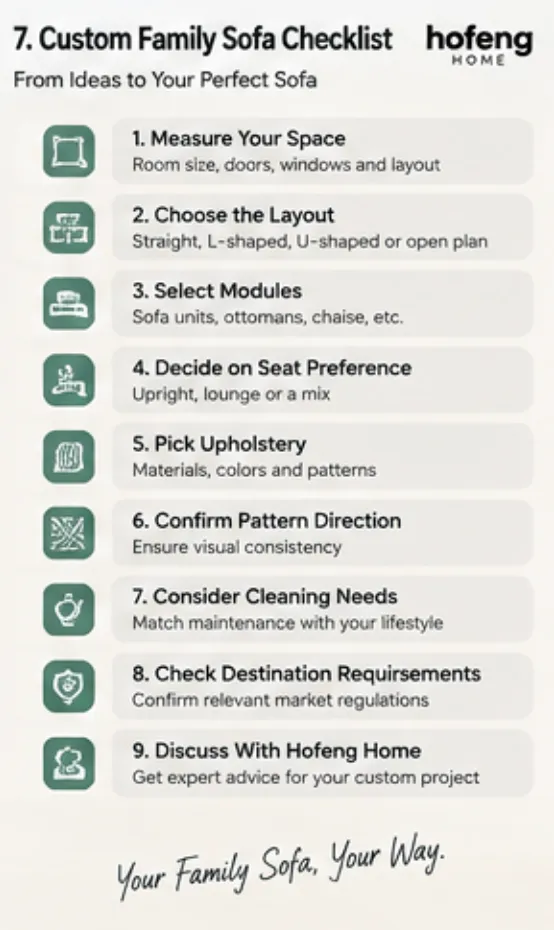
For most buyers wondering how to choose a couch, the process becomes much easier when the decision is made in the right order.
First, measure the room and determine the maximum sensible footprint. Second, decide how many people need to sit comfortably and how the room is actually used. Third, choose between fixed and modular furniture. Fourth, evaluate upholstery for cleaning, texture and appearance. Finally, confirm construction, customization and ordering details.
For a custom sofa, prepare the following information before requesting a quotation:
This gives a manufacturer far more useful information than simply asking for “the best kid proof couch.” Discuss a custom family sofa project now.
One common mistake is assuming darker upholstery automatically solves family maintenance. Color can disguise some marks, but it cannot compensate for unsuitable cleaning requirements.
Another is buying by fabric category alone. “Performance fabric,” “velvet,” “polyester” or “leather” describes only part of the material.
A third mistake is treating one extreme abrasion rating as proof of long lifespan. ACT specifically advises against this interpretation.
Families also frequently underestimate the assembled footprint of a large sectional. Always plan the room around the complete configuration, not the dimensions of one piece.
Finally, do not assume “kid friendly,” “kid proof” and “child safe” are interchangeable. Practical family suitability and formal product safety are different questions.
There is no single best material for every family. A practical choice usually combines appropriate surface construction, manageable cleaning requirements, sufficient durability for the intended use and a texture the household enjoys.
A kid friendly couch fits the room, accommodates normal family use, has practical upholstery and can be maintained without excessive effort. Comfortable proportions and sensible configuration matter alongside durability.
They can be, but “performance fabric” is a broad term rather than one universal specification. Check the specific textile’s performance data, construction and cleaning instructions before buying.
Neither is universally better. Mid-tones, multicolor textures and patterns can sometimes make small everyday marks less visually obvious, while the best choice still depends on the room and maintenance habits.
Yes, modular sofas can be useful when a family values layout flexibility. Compatible modules may allow the arrangement to change as room use or household needs evolve, subject to the design of the system.
The best sofa for families with toddlers is one that fits the room, provides comfortable family seating and has upholstery with realistic maintenance requirements. Do not assume that low seating alone makes a sofa child-safe.
No. Removable and machine washable are separate characteristics. Always follow the cleaning instructions for the exact upholstery and cover construction.
Durability depends on multiple characteristics rather than one fiber or test number. Abrasion resistance is useful, but seam performance, construction, cleaning, usage and other textile properties also affect how upholstery performs.
It can be excellent for lounging and movie nights when the room is large enough. Measure the complete footprint and consider whether family members also need more upright seating.
Yes, when the manufacturer provides customization. Hofeng Home can evaluate modular combinations, upholstery choices and technically feasible dimensions for custom projects, with final feasibility confirmed before production.
The best kid friendly couches are not the sofas with the strongest marketing claims. They are the ones whose design, upholstery, comfort, room footprint and maintenance requirements match the way a real family lives.
Start with the room. A sofa should provide enough seating without making circulation awkward or overwhelming the available floor area. Then consider how the family uses it. A deep sectional may suit long movie nights and relaxed lounging, while a more upright configuration may work better in a multi-purpose living room.
Next, evaluate the upholstery as a complete material rather than shopping by fiber name or one impressive test figure. Surface construction, cleaning instructions, pattern, color and documented textile performance all matter. Abrasion testing can help compare fabrics, but it cannot predict exactly how long a sofa will last.
Modular furniture becomes particularly useful when flexibility has practical value. A household that moves, expands or regularly changes the way a living room functions may benefit from independent modules that can be reconfigured rather than one permanently fixed sofa arrangement.
For custom projects, the strongest results come from good specification. Room dimensions, module orientation, upholstery references, pattern direction, comfort expectations and destination-market requirements should be discussed before manufacturing begins.
Hofeng Home Furniture is a global custom furniture manufacturer specializing in customizable modular sofa systems and coordinated living-space furniture. Its Mahjong-style modular furniture can be configured through independent modules, with customization options covering module combinations, technically feasible dimensions, upholstery materials, patterns, textures, colors and overall configurations. The company also supports OEM & ODM projects for homeowners, designers, retailers and international project buyers.
If you are developing a family room, sourcing a customized modular collection or planning an OEM/ODM project, send Hofeng Home your room dimensions, intended layout, upholstery preferences and project requirements so the configuration and manufacturing feasibility can be evaluated before production.

Hi, I’m Bella Lui! I’ve spent the past 10 years fully immersed in the custom furniture industry, with my biggest passion and expertise lying in tailor-made mahjong sofas. I’ve walked through full customization journeys with over 500 clients overseas, helping them craft one-of-a-kind modular seating that balances gaming comfort, home style and space limits.
Every blog post comes from real on-site experience: factory visits, client consultations, upholstery trials and hundreds of solved custom design headaches. I’m here to share everything you need to know before ordering a custom mahjong/modular sofa—no confusing jargon, just honest, actionable advice based on a decade of hands-on client projects.