

A deep couch can transform a sofa from a place to sit into a genuine lounging space. The extra seat area gives you room to recline, sit cross-legged, curl up with a book, share the sofa with children, or stretch out during a movie. That is why terms such as deep sofa, deep seat couch, extra deep sofa, and “cloud-style sofa” have become common in furniture searches.
Yet depth alone does not make a sofa comfortable.
A couch can look exceptionally deep in a product photograph while offering much less usable seating once thick back cushions are installed. Another can provide generous seat depth but feel uncomfortable for upright sitting because the seat height, back angle, cushion firmness, and user’s body proportions are poorly matched. An oversized extra deep sofa may also overwhelm a room even when its width technically fits against the wall.
For buyers, the important question is therefore not simply, “How deep should a couch be?” It is: How much usable depth suits the way you sit, the people using the sofa, and the space around it?
This guide explains what is considered a deep couch, how to interpret sofa depth measurements, how deep seating affects posture and room planning, what makes a deep cushion sofa durable, and how upholstery, modularity, construction, maintenance, and manufacturing decisions influence the finished product. It also covers what homeowners, designers, retailers, and project buyers should confirm before ordering custom furniture.
For projects requiring more control over size, upholstery, and configuration, Hofeng Home Furniture also manufactures customizable modular sofa systems for residential and project applications.
A deep couch is a sofa designed with more front-to-back seating space than a conventional upright sofa, allowing the user to sit farther back, recline more naturally, or bring the legs onto the seat.
There is no single universal industry measurement that legally defines a sofa as “deep.” Furniture sellers therefore use the term somewhat differently. As a practical market convention, usable seat depths around the mid-20-inch range and above are commonly described as deep, while particularly generous lounge-oriented designs may extend substantially farther.
The important word is usable.
Overall depth and seat depth are not the same measurement.
Overall sofa depth is usually measured from the furthest point at the back of the sofa to the furthest point at the front. It includes the back structure, back cushions, and seat.
Usable seat depth is the space available for your body, typically measured from the front surface of the back cushion to the front edge of the seat cushion.
For example, two sofas could both have an overall depth of approximately 42 inches but feel completely different. A sofa with a thick upholstered back and large loose cushions may have significantly less usable seating area than a slimmer-backed design.
This distinction is one of the most important things to check when comparing deep couch dimensions online. Product pages that list only overall depth do not always tell you how the sofa will actually feel when sitting.
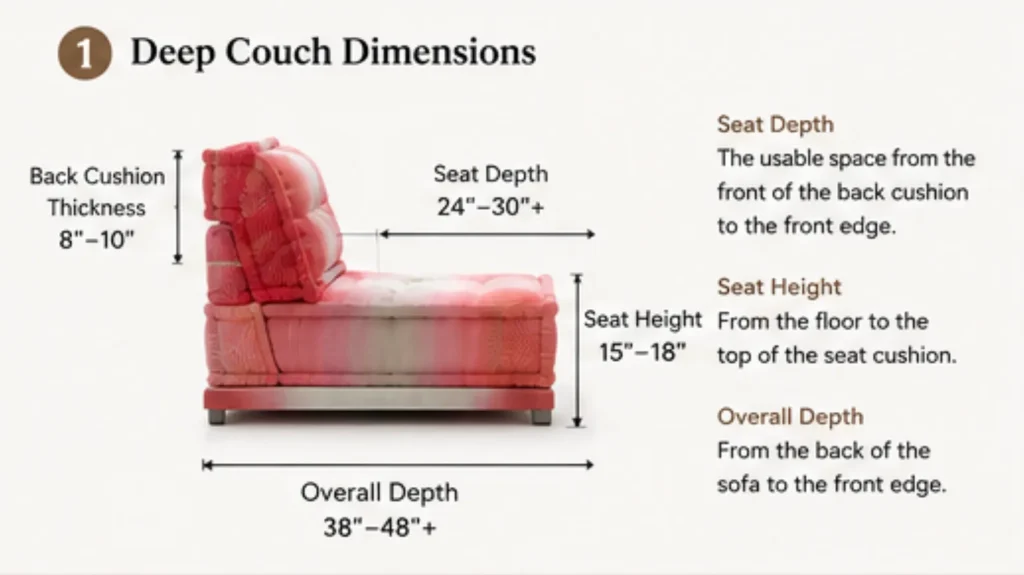
An extra deep sofa pushes the design further toward lounging. It may accommodate cross-legged sitting, curled-up positions, multiple throw cushions, or reclining without requiring a chaise.
Extra depth can be appealing in family rooms, media rooms, large open-plan interiors, and relaxed living spaces. It is less automatically suitable for formal sitting rooms or compact rooms where circulation is limited.
Deep should therefore be treated as a functional design choice, not automatically as an upgrade.
For most buyers, the right couch depth depends on body size, preferred sitting position, cushion thickness, and how the room will be used.
Someone who sits upright with both feet on the floor generally needs less seat depth than someone who prefers to recline, tuck their feet underneath them, or lie sideways. Taller users may appreciate additional thigh support, while shorter users can find an extra deep couch difficult to sit against without adding a lumbar or back cushion.
Rather than shopping from one “ideal” number, compare the following measurements together:
| Measurement | Why It Matters | What to Check |
|---|---|---|
| Overall sofa depth | Determines room footprint | Clearance from walls, tables and walkways |
| Usable seat depth | Determines sitting and lounging space | Measure with back cushions in position |
| Seat height | Influences posture and ease of standing | Consider user height and intended use |
| Seat width | Determines lateral personal space | Important for a wide seat sofa or modular unit |
| Back height/angle | Changes support and perceived depth | Deep seats often encourage a more reclined posture |
| Cushion thickness | Can reduce usable depth | Confirm dimensions in the final upholstered state |
This is why a sofa seat depth of 24 inches, for example, cannot be judged in isolation. Its comfort will change depending on whether the back cushion is firm and thin, soft and oversized, upright, or angled.
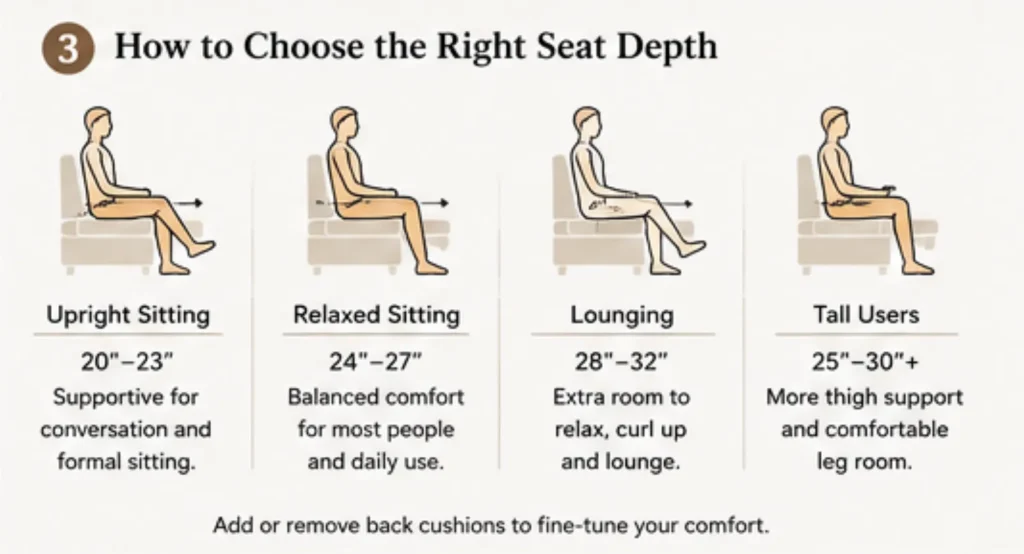
One useful buying exercise is to sit on an existing sofa and measure the distance from behind your lower back to the front of the seat in your preferred position.
If you normally place cushions behind you, include them in the measurement. If you sit cross-legged, measure the space your legs realistically occupy. If several people with very different heights will share the sofa, test more than one person.
For a custom sofa, this information is far more useful than simply requesting “the deepest couch possible.”
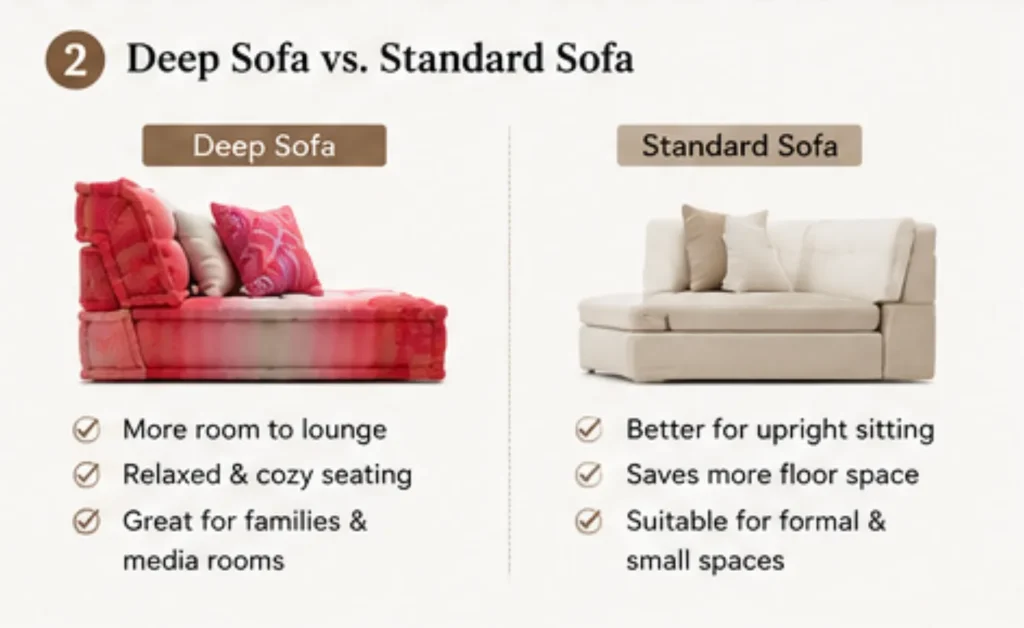
Neither design is universally better. The correct choice depends on activity and space.
A conventional sofa generally supports upright conversation efficiently and uses less floor area. A deep sitting couch prioritizes relaxed seating and gives users more freedom to change position.
| Consideration | Standard-Depth Sofa | Deep Sofa |
|---|---|---|
| Upright sitting | Usually easier | May require back cushions for some users |
| Lounging | Moderate | Excellent when proportions are well designed |
| Cross-legged sitting | More limited | Usually easier |
| Room footprint | Smaller | Larger |
| Formal spaces | Often suitable | Depends on silhouette |
| Media/family rooms | Suitable | Particularly well suited |
| Smaller users | Often easier to fit | Extra cushions may help |
| Modular lounging layouts | Possible | Especially effective |
A deep comfy couch works particularly well when the household treats the sofa as an everyday living platform rather than occasional guest seating.
This distinction becomes even more important with modular furniture. Instead of forcing one fixed sectional into a room, independent modules can potentially be rotated, rearranged, expanded, or separated as the function of the space changes.
The most comfortable deep couch is not necessarily the deepest one. Comfort comes from the relationship among depth, seat height, cushion response, back support, width, and the user’s preferred posture.
As seat depth increases, sitting fully against the backrest becomes more difficult for people with shorter legs. Without sufficient support, the user may either sit forward and lose back support or recline farther than intended.
That is not inherently a problem. Many deep seated couches are deliberately designed for relaxed rather than formal posture. The problem occurs when a buyer expects both extremely deep lounging and conventional upright ergonomics from the same fixed geometry.
Loose back cushions can make a deep sofa more adaptable because users can add or remove support. For households with people of different heights, flexible cushion arrangements are often more practical than expecting one seat dimension to fit everyone identically.
A soft cushion allows the body to settle farther into the sofa. A firmer cushion keeps the body higher and can make the same measured seat feel more controlled.
Cushion construction may involve different combinations of foam, fiber, batting, feathers, springs, or other resilient materials. Each affects initial softness, recovery, edge support, maintenance, and appearance differently.
Because Hofeng Home’s approved specifications do not establish one fixed foam density or cushion construction for all products, buyers should confirm the proposed cushion specification for the individual model or custom project rather than assuming that all deep sofas use the same internal structure.
A low, extra deep couch creates an informal lounge posture. Visually, it can also make a large sofa appear less bulky because the silhouette stays close to the floor.
The trade-off is that very low seating may be less convenient for people who prefer a higher, more upright sitting position. Combining unusually low height, very soft cushioning, and extreme depth pushes the design strongly toward lounging.
A well-specified deep couch therefore considers all three variables together.
Before looking at deep couches for sale, measure the room rather than only the wall.
The sofa may fit against the wall and still make the living room uncomfortable because sofas occupy circulation space in three dimensions. Deep furniture projects farther into the room, reducing the distance between the sofa and coffee table, media unit, fireplace, opposite seating, doors, or walkways.
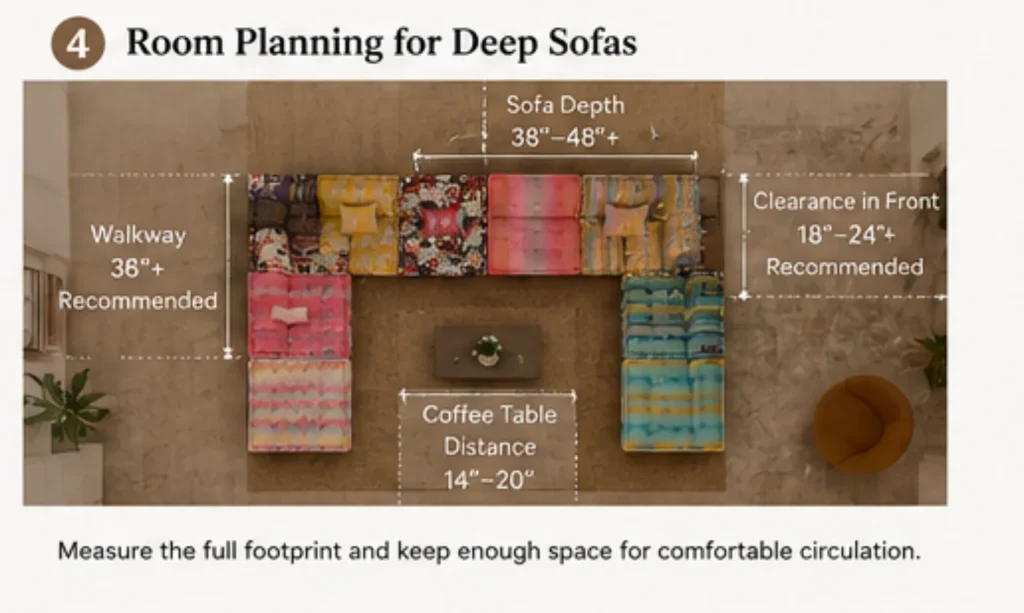
Mark the full sofa footprint on the floor with removable tape, cardboard, or paper.
Then move around the room as you normally would. Open doors. Walk between seating areas. Pull out nearby chairs. Consider where side tables, lamps, rugs, and other furniture will sit.
For a large deep couch, this simple exercise can reveal spatial problems that a floor plan viewed on a screen may hide.
In an open-plan home, the opposite can also happen: a conventional sofa may look undersized, while a substantial deep sectional can anchor the living zone and create a clearer boundary between lounging, dining, and circulation areas.
Overall dimensions matter before the sofa ever reaches the living room.
Check doors, corridors, elevators, stair turns, landings, and other restricted access points. Modular sofas have an advantage here because smaller independent components may be easier to move through buildings than a single large sofa body.
However, module size still matters. A modular product should never be assumed to fit merely because it separates into pieces.
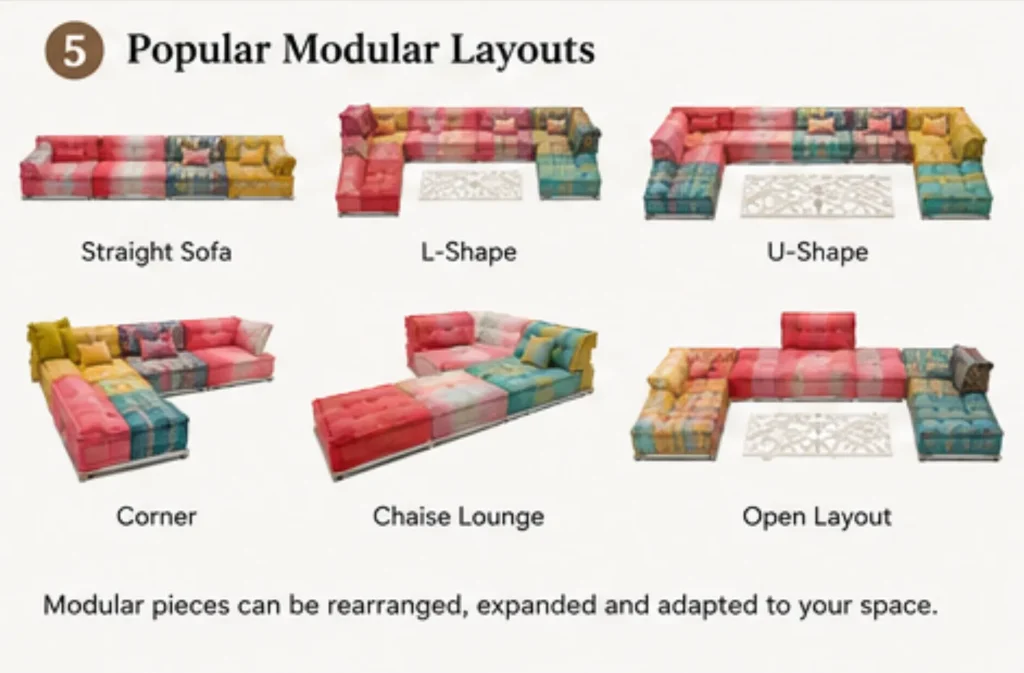
A fixed deep sofa gives you one arrangement. A modular deep sofa can provide more flexibility because the seating system is divided into independent units.
Depending on the system, modules may include armless seats, corner units, chaise-style sections, ottomans, or other elements. Different modules can create straight sofas, L-shaped layouts, wide lounge zones, corner arrangements, or open configurations.
Hofeng Home’s Mahjong-style modular sofa category is based on independent furniture modules that can be combined and rearranged. Depending on the selected configuration, units may be rotated, combined, expanded, or reconfigured for different spaces.
Imagine specifying a three-module sofa for an apartment and later moving into a larger open-plan home. With a compatible modular system, it may be possible to use the existing modules in a different arrangement and expand the configuration rather than replacing the entire sofa.
Similarly, a designer working with an irregular room may use independent pieces to avoid forcing a conventional rectangular sectional into an unsuitable geometry.
This adaptability is particularly useful in:
Not every proposed module dimension or layout is structurally feasible, however. Custom dimensions must be evaluated against the construction, cushion proportions, upholstery behavior, and manufacturing requirements before production.
The right format depends on how people use the room.
A straight deep sofa works well when you want generous lounging without occupying multiple walls. It can pair with chairs or ottomans to keep the layout visually open.
A deep seated sectional couch is more effective when the goal is to accommodate more people, create a defined social zone, or use a corner efficiently. L-shaped configurations work well in many family rooms, while larger U-shaped configurations can support conversation in spacious interiors.
For buyers researching the best deep sectional, pay attention to how the corner works. Some corner modules provide comfortable usable seating; others primarily connect two runs of seats and may feel less functional.
A curved sofa uses geometry differently. Rather than following two straight walls, its arc can visually soften a large room and turn seating slightly toward other users.
Curved layouts can be effective for conversation and open-plan zoning, but they require more careful spatial planning. The empty areas around a curve may make a sofa with similar nominal dimensions occupy more usable floor space than expected.
For custom curved or irregular configurations, dimension drawings are especially important before production.
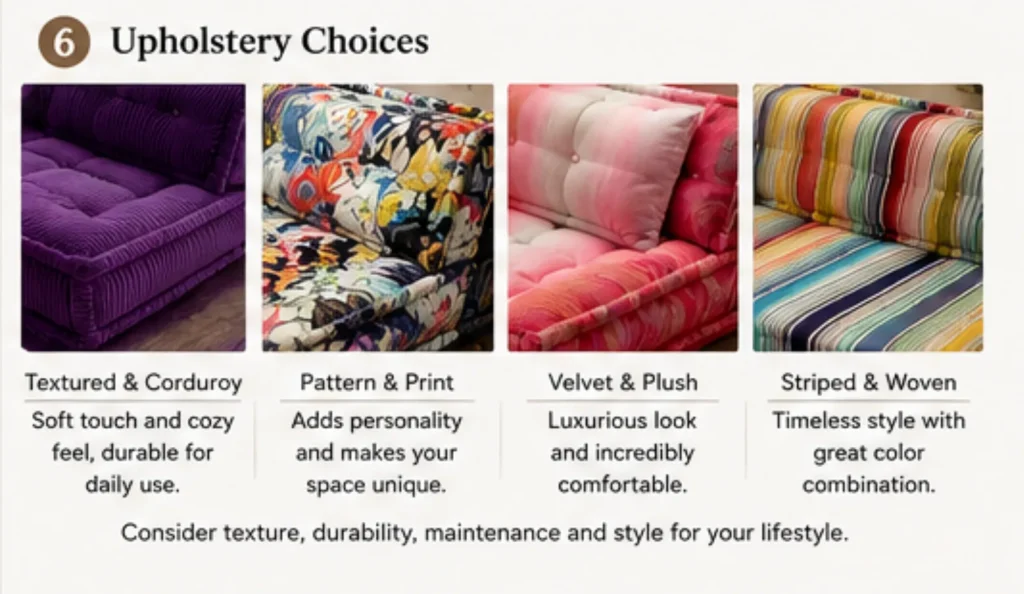
A deep lounge sofa is likely to receive prolonged contact, repeated movement, and frequent use. Upholstery therefore affects much more than appearance.
When choosing fabric, consider texture, abrasion behavior, pilling, colorfastness, seam performance, cleaning requirements, pattern scale, and end use.
Abrasion testing is useful, especially for project upholstery, but higher numbers do not automatically mean proportionally longer life.
The Association for Contract Textiles (ACT) specifically warns that Wyzenbeek and Martindale results are not directly interchangeable and that laboratory abrasion results alone cannot predict service life. ACT also notes that cleaning, maintenance, application, and other real-world factors influence performance.
For high-traffic woven upholstery in public spaces, ACT publishes voluntary performance guidance including abrasion criteria, while also emphasizing that test values beyond its guidelines should not be interpreted as a direct estimate of furniture lifespan.
This is useful for designers and project buyers: do not ask only, “How many rubs?” Ask whether the textile is appropriate for the actual environment.
A heavily textured textile can create visual depth and make a large sofa feel warmer, but pronounced textures may catch debris or require more attention during cleaning.
Smooth tightly woven materials can create a more tailored appearance. Velvet can produce dramatic color variation as the pile changes direction. Leather develops differently from woven fabrics and may show natural variation and use marks.
There is no universally superior upholstery. The correct choice depends on the room, expected traffic, maintenance tolerance, aesthetic direction, pets, children, commercial use, and local product requirements.
Hofeng Home allows customers to customize upholstery materials, patterns, textures, and colors for suitable projects.
[Internal Link: Upholstery or Customization Page + Recommended Anchor Text: explore custom upholstery options]
A custom deep couch involves more upholstery planning than choosing a swatch.
On a solid fabric, slight changes in panel orientation may be visually insignificant. On stripes, checks, large florals, directional textures, or graphic prints, they can become obvious.
Manufacturing teams must consider how a pattern travels across:
This creates an important design trade-off in a colorful modular sofa. Perfect pattern continuity across one fixed configuration may look impressive, but rearranging those modules later can break the alignment. In some designs, treating each module as an independent composition is therefore more compatible with modularity.
Fabric direction matters with pile textiles as well. Upholstery panels viewed from different directions can reflect light differently and appear to vary in color even when they come from the same material.
These details should be decided before cutting rather than treated as cosmetic corrections at the end of production.
Searches such as “who makes the best quality sofas” or “best couch brands” often lead to brand lists. Brand reputation can be useful, but buyers comparing sofa quality should also ask for product-level information.
A deep sofa places particular importance on structural geometry because the seating surface extends farther from the back support. Cushion behavior, base support, seams, module interfaces, and edges must work together.
Instead of asking only whether a cushion is “soft,” ask:
What materials create the seat feel? Does the cushion need regular reshaping? Are the cushions fixed or loose? How is the edge supported? How does the specified construction recover after prolonged sitting?
For very soft cloud-style seating, maintenance may be part of the desired aesthetic. A highly relaxed cushion can develop folds and require reshaping more often than a tightly upholstered, structured cushion.
Neither is inherently better. They serve different preferences.
Modular sofas introduce another consideration: movement between sections.
Different systems may rely on the weight and geometry of the modules, friction, connectors, or other joining methods. The suitable approach depends on product design and intended use.
Project buyers should clarify the proposed method because frequent rearrangement and a permanently fixed-looking installation create different requirements.
If multiple modules are intended to align, small inconsistencies can become visible at adjoining seams, platform edges, or cushion heights.
Manufacturing quality control should therefore consider finished dimensions as a coordinated system rather than treating every module as an unrelated upholstered object.
For patterned configurations, visual alignment adds another inspection point.
A family sofa usually benefits from flexible seating positions, forgiving upholstery, and enough room for several people to relax without feeling crowded.
A deep seat sofa is particularly useful when family members often curl up, watch films, read, or share the sofa with children. Maintenance should be considered from the beginning, especially with light-colored upholstery or highly relaxed cushioning.
Taller users often appreciate extra thigh support and greater seat depth. Still, overall proportion matters. Seat height, back support, and cushion response should remain comfortable rather than simply maximizing depth.
An extra deep couch may still work well, particularly for lounging, but additional back support may be needed for upright seating.
Loose cushions give households with different body proportions an easy way to adjust usable depth without redesigning the entire sofa.
If conversation is the priority, seating orientation matters almost as much as depth.
A large straight sofa places people beside one another. An L-shaped sectional, curved sofa, or multiple modular pieces can turn people toward each other more naturally.
A very deep sofa is not automatically unsuitable for a small home, but the trade-off must be worthwhile.
In some rooms, a single deep modular seat plus an ottoman may provide more flexible lounging than an oversized fixed sectional. Modular pieces can also help adapt the layout when the same room serves multiple purposes.
Ready-made furniture works well when existing sizes, fabrics, and configurations match the room. It is also simpler for buyers who do not need detailed design control.
Custom furniture becomes more useful when standard proportions create compromises.
A custom or OEM/ODM project may allow decisions to be coordinated around module combinations, technically feasible dimensions, upholstery, fabric patterns, textures, colors, and overall configuration.
Hofeng Home Furniture provides factory-direct furniture manufacturing and one-stop OEM and ODM customization services for international customers, including homeowners, designers, retailers, and project buyers.
That does not mean every requested measurement should simply be manufactured as drawn. Furniture geometry affects structural support, upholstery behavior, cushion proportions, pattern consumption, packaging, and module compatibility. Technical feasibility should be reviewed before production.
Interior designers working with deep modular seating should send more than a reference image.
Useful project information includes the room plan, finished sofa footprint, module arrangement, required dimensions, upholstery selection, visible fabric direction, pattern placement expectations, color references, and any access limitations.
A dimensioned configuration drawing reduces ambiguity because terms such as “wide,” “oversized,” and “extra deep” are subjective.
For a multi-module project, also identify which edges will touch other modules and which remain exposed. That can influence upholstery finishing and inspection priorities.
If a design includes several upholstery colors or patterns, number every module and match it to the layout drawing. A numbered specification is much safer than instructions such as “put the green piece beside the floral seat.”
Retailers, developers, hospitality buyers, and other professional purchasers must think beyond appearance because the finished furniture may need repeatability, documented specifications, appropriate packaging, regulatory evaluation, and consistent production communication.
A sample, prototype, or approved specification can help establish expectations for dimensions, seat feel, seams, upholstery appearance, colors, labels, and finishing.
The exact confirmation process varies by project. The underlying principle is consistent: subjective instructions such as “make it softer” or “use a premium fabric” are difficult to reproduce. Approved materials and measurable requirements create a clearer manufacturing target.
For commercial interiors, the aesthetic fabric chosen by a designer still needs to suit its intended application.
ACT’s guidelines evaluate characteristics beyond abrasion, including elements such as physical properties, pilling and other textile performance considerations.
For large orders, buyers should identify applicable project standards before approving materials rather than assuming that a residential upholstery specification is suitable for every commercial environment.
Deep sofas are bulky products. Modular designs can help divide the shipment into manageable units, but every package must still account for vulnerable upholstered surfaces, corners, projections, moisture exposure, movement in transit, and identification of individual modules.
A useful packaging specification also considers what happens at destination. If ten visually similar modules arrive for one project, clear package and module identification can greatly simplify installation.
Product compliance should be evaluated for the destination market rather than assumed from the appearance or general category of the sofa.
In the United States, the Consumer Product Safety Commission states that upholstered furniture covered by the federal standard is subject to flammability requirements codified in 16 CFR Part 1640, along with applicable certification and labeling obligations.
In the United Kingdom, domestic upholstered furniture is covered by the Furniture and Furnishings (Fire) (Safety) Regulations framework. Amendments that came into force on 30 October 2025 changed several requirements, so buyers should rely on current government guidance rather than old compliance summaries.
For the European Union, Regulation (EU) 2023/988, the General Product Safety Regulation, applies to consumer products within its scope and requires economic operators to address product safety, documentation, traceability, and related responsibilities. It has applied since 13 December 2024.
These examples are not a complete compliance checklist for every furniture project. Importers, retailers, manufacturers, and project buyers should determine the rules applicable to the specific product, use case, and destination before placing goods on the market.
One common mistake is buying according to overall depth rather than usable seat depth. Thick back cushions can materially change the space available for sitting.
Another is ignoring circulation. A large deep couch may fit the dimensions of the room while leaving too little functional space between furniture.
Buyers also sometimes select upholstery from photographs alone. Screen color, lighting, texture, and pile direction can make a digital image an unreliable representation of the final material.
With custom furniture, another risk is approving only the general appearance while leaving important details open to interpretation. Upholstery, dimensions, module sequence, pattern orientation, cushion expectations, and destination requirements should be clarified before manufacturing progresses.
Finally, do not assume that the best deep seated couch is the softest or largest. A sofa should match how it will actually be used.
Maintenance depends heavily on the upholstery and cushion construction, so always follow care instructions provided for the specific material.
As a general practice, remove loose debris before it becomes embedded in the textile. Deal with spills according to the cleaning method appropriate for the upholstery rather than automatically applying household cleaning chemicals.
If the sofa uses loose or highly relaxed cushions, periodic rotation, repositioning, or reshaping may help distribute wear and maintain appearance. Cushions with very soft lounge-oriented construction may naturally show more creasing than tightly tailored seating.
Direct sunlight can also influence the appearance of many materials over time. Room orientation, glazing, and fabric colorfastness should therefore be considered when positioning upholstered furniture near strong windows.
For modular sofas, inspect the arrangement occasionally as well. If units have shifted through daily use, return them to their intended positions and check any applicable joining components according to the product instructions.
A deep couch generally provides more usable front-to-back seat space than a conventional upright sofa. There is no universal measurement that defines “deep,” so compare usable seat depth rather than relying only on the product label.
Sofa dimensions vary considerably by style and manufacturer. Instead of using one universal number, compare overall depth and usable seat depth separately because thick backs and cushions can substantially change the actual sitting area.
A usable seat depth around 24 inches is commonly marketed in the deeper range by furniture sellers, although there is no universal standard. Whether it feels deep also depends on seat height, back cushions, back angle, and the user’s proportions.
They can be, particularly for lounging, but shorter users may need an additional back or lumbar cushion to sit upright with adequate support. Removable back cushions make a deep sofa easier to adapt to different users.
Depth measures front-to-back seating space, while width measures side-to-side space. A sofa can have deep but narrow seats, wide but shallow seats, or combine both dimensions.
It can work if the room still has adequate circulation and the added lounging space is valuable. Mark the full sofa footprint on the floor before ordering rather than checking wall length alone.
A deep sectional is useful for larger households, corners, media rooms, and lounging, while a straight sofa may preserve more open floor space. The better choice depends on room geometry and seating behavior.
Confirm the overall dimensions, usable seat depth, module arrangement, upholstery, cushion specification, access route, color or pattern direction, and applicable destination requirements. Custom dimensions should also be reviewed for technical feasibility before production.
It can if the sofa system is designed for modular reconfiguration. Hofeng Home’s modular systems use independent modules that can be combined and rearranged according to the selected configuration, although compatibility and project-specific feasibility should be confirmed.
Yes. Hofeng Home provides factory-direct custom furniture manufacturing and OEM/ODM services for homeowners, designers, retailers, project buyers, and other international customers. Specifications should be confirmed before production, particularly for custom dimensions, upholstery, and multi-module layouts.
A deep couch is most successful when its extra depth solves a real comfort or lifestyle need. It gives people more room to recline, curl up, sit cross-legged, stretch out, or share a generous seating area, which makes deep sofas especially suitable for family rooms, media spaces, informal living rooms, and many modular layouts.
Depth by itself, however, is not a reliable measure of comfort or quality.
Start with usable seat depth rather than overall sofa depth. Then assess seat height, cushion response, back support, width, room circulation, and the body proportions of the people who will use the sofa. A 24-inch deep seat with substantial back cushions can feel very different from another sofa carrying the same nominal measurement.
Space planning is equally important. An oversized extra deep sofa needs enough area in front of it for normal circulation and surrounding furniture. In smaller or changing spaces, modular seating can provide a useful alternative because independent components may be rearranged instead of committing the room permanently to one sectional shape.
Material and manufacturing decisions deserve the same attention. Upholstery should be chosen according to use, maintenance, texture, pattern, and relevant performance requirements rather than appearance or abrasion numbers alone. Custom projects should also define module dimensions, cushion expectations, seam and pattern alignment, color references, finishing, packaging, and applicable destination-market requirements before production.
For homeowners, the result is a sofa better matched to daily life. For interior designers, modularity provides another tool for controlling proportion and zoning. For retailers and project buyers, precise specifications improve communication and production consistency.
Hofeng Home Furniture specializes in customizable modular sofa systems and coordinated living-space furniture, including factory-direct OEM and ODM solutions for international customers. Module combinations, upholstery materials, colors, textures, patterns, and technically feasible dimensions can be evaluated according to individual project requirements.
If you are planning a residential configuration, retail collection, or project order, submit your room dimensions, desired layout, upholstery direction, and other specifications so the appropriate configuration can be evaluated before production.

Hi, I’m Bella Lui! I’ve spent the past 10 years fully immersed in the custom furniture industry, with my biggest passion and expertise lying in tailor-made mahjong sofas. I’ve walked through full customization journeys with over 500 clients overseas, helping them craft one-of-a-kind modular seating that balances gaming comfort, home style and space limits.
Every blog post comes from real on-site experience: factory visits, client consultations, upholstery trials and hundreds of solved custom design headaches. I’m here to share everything you need to know before ordering a custom mahjong/modular sofa—no confusing jargon, just honest, actionable advice based on a decade of hands-on client projects.